
Why We Start Here
Lesson 1 gave you the map of the Bible. Lesson 2 answered why your Bible has 66 books. This lesson gives you the skill everything else depends on: how to study a passage by yourself.
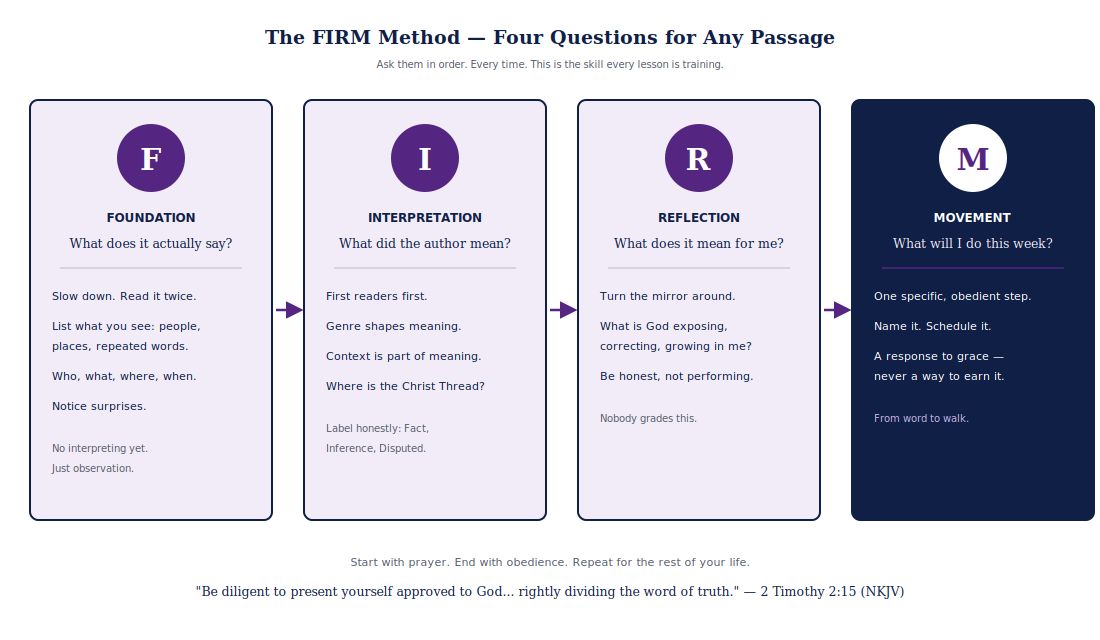
Here is the honest goal, stated plainly: we want this curriculum to make itself unnecessary. Not because the lessons are bad — because you will have learned to see. Every FIRM lesson follows the same four movements, and those movements are not just a format. They are a transferable skill. By the time you finish this lesson, you will have run the full method twice — once watching it done, once doing it yourself — on real passages, with real observations you made with your own eyes.
A warning before we begin: this lesson only works if you do the work before you read ours. When you reach the practice passage, close this book's answers (metaphorically — they're a few pages ahead), pick up a pen, and try. Your first attempt will be clumsy. That's not failure; that's the first rep. Nobody learns to see by watching someone else look.
Check What You Think You Know
Many sincere Christians carry quiet assumptions about Bible study that were never quite true. See if any of these sound familiar — there is no shame in them:
- "Good Bible study starts with 'what does this mean to me?'" It feels spiritual, but it's backwards. If you start with yourself, you'll find yourself in every text — including texts that aren't about you. Meaning first, then application. The order matters.
- "If I pray before I read, I don't need to study carefully." Prayer is essential — but the Holy Spirit works through careful reading, not instead of it. God gave you a mind and a text in a language; using both carefully is not unspiritual. It's stewardship.
- "I need commentaries and Greek to really understand." Tools help, but they are not the doorway. The doorway is slow, honest observation of the English text in front of you. Most of what transforms readers is visible to anyone willing to look twice.
- "The goal is finding the deeper, hidden meaning." Sometimes the "deeper meaning" people find is just their imagination with a Bible verse attached. The real depth of Scripture is in what the author actually meant — which is usually deep enough to rearrange your life without any decoding.
Hold those corrections loosely for now. This lesson will prove them by demonstration, not just assertion.
Before You Read: Open My Eyes
Method without dependence produces proud readers, not formed ones. Pray this before you go further:
"Open thou mine eyes, that I may behold wondrous things out of thy law." — Psalm 119:18 (KJV)
Father, today I learn to study Your Word for myself — not to borrow someone else's conclusions, but to see what's actually there. Slow me down. Teach me to observe before I interpret, to ask honest questions, and to let the text speak first. Make me a careful reader, not a careless one. In Jesus' name, amen.
Here is our passage — all twelve words of it. Read it twice, slowly, before you read another word of this lesson:
"The beginning of the gospel of Jesus Christ, the Son of God." — Mark 1:1 (KJV)
Now watch what careful observation does with twelve words. Below is the kind of list a trained reader makes before interpreting anything. Notice how much is simply seen — no commentary needed yet:
What we see (observation only):
- "The beginning" — Mark opens with a beginning. The phrase echoes Genesis 1:1 ("In the beginning"), which his first readers — steeped in the Greek Old Testament — would have heard immediately. Mark is announcing a new Genesis, a new start to the story.
- "of the gospel" — Gospel translates the Greek euangelion: a royal announcement, good news of a victory or a new king. This was not a religious word first; it was an imperial word. A famous inscription from 9 BC hails the birth of the emperor Augustus as euangelion — "good news" — for the whole world. Mark takes the empire's word and applies it to someone else.
- "of Jesus Christ" — Christ is not Jesus' last name. It is the Greek translation of Messiah: the Anointed One, the promised King of Israel. Mark puts the title in the first sentence — no buildup, no mystery yet. This is who the book is about.
- "the Son of God" — the climax of the sentence. In the Roman world, "son of god" was Caesar's title — Augustus was officially divi filius, son of the deified Julius. Mark applies the emperor's title to a crucified carpenter from Nazareth. The collision is the point.
- The sentence is a title, not a story yet. Mark doesn't begin with "once upon a time." He begins with a declaration, like the heading over a royal proclamation. Everything after this verse has to be read as evidence for this claim.
- Twelve words, zero verbs of action. Nothing has happened yet. Mark 1:1 is all announcement — the action starts in verse 2. The Gospel of action opens standing perfectly still, letting the claim ring.
That is Foundation: six observations, every one of them visible in the text or its immediate background, none of them requiring a commentary. You could have seen all six. That is the point of this exercise — the skill is not mysterious. It is slow attention plus honest questions.
The honesty labels, applied to what we just saw:
- Fact: the Greek words and their standard meanings; "Christ" as title, not surname; the imperial use of "gospel" and "son of god" language in the Roman world.
- Inference: that Mark intends the Genesis echo and the imperial contrast. The echoes are real and widely recognized, but intention is a careful conclusion, not a quoted fact.
- Disputed: whether Mark's original ending (the debated longer/shorter endings of chapter 16) affects how verse 1 frames the book. Scholars disagree; it doesn't change what verse 1 says.
Notice what the labels do: they let you hold the observations with full confidence while staying honest about which kind of confidence each one deserves. That honesty is the skill.
Observation asks what is there. Interpretation asks what Mark meant by putting it there — what his first readers would have heard.
What the first readers heard: A Jewish reader heard Genesis and the Messiah — the true King has arrived, and the story of Israel is starting over. A Roman reader heard a political earthquake — the titles of Caesar applied to someone else. Mark meant both. His Gospel will spend sixteen chapters proving the claim of verse 1, and the proof will look nothing like anyone expected: the King wins by dying.
The theology in one sentence: Before Mark tells you anything Jesus did, he tells you who Jesus is — and the "who" interprets everything that follows. Every healing, every confrontation, every parable lands differently once you know the Son of God is the one doing them. Identity before activity: that is Mark's order, and it's ours too.
A hard question, faced honestly: If Mark announces Jesus as Son of God in verse 1, why does Jesus keep telling people not to say so (the "Messianic secret" of Mark 1:44, 3:12, 8:30)? Inference: because a misunderstood title is worse than a hidden one — the crowds wanted a political liberator, and Jesus refuses the crown on their terms before accepting it on His (Mark 10:45). The tension is real, and Mark built it in on purpose.
The Christ Thread: This verse doesn't merely point to Christ — it is the announcement of Christ. Mark 1:1 is the thesis statement of the whole Gospel: Jesus Christ, Son of God, and everything after is the evidence. When you study Mark with FIRM, you'll watch this thread pull tight through every chapter until a Roman centurion — of all people — confesses it at the cross (Mark 15:39).
Your Turn: Psalm 23:1
Same movement. New passage. Your eyes this time.
Here is your practice passage — nine words, some of the most familiar in the Bible. Familiarity is the enemy of observation, which is exactly why it's perfect practice:
"The LORD is my shepherd; I shall not want." — Psalm 23:1 (KJV)
Rules for this exercise:
- Do not read the debrief section yet. It's right below — resist it.
- Get a pen. In the space below (or a notebook), make your own observation list. Aim for at least five things you see.
- Then answer the interpretation questions beneath.
- Only then, compare with "How Did You Do?"
Foundation prompts — what do you see?
- Who is speaking? Who is the "my"? (Think about who wrote this psalm.)
- "LORD" is in all capitals in most Bibles. Why? What name does it represent?
- What does a shepherd do, in the ancient world? What would that image have meant to the first readers?
- "I shall not want" — what is being claimed? What is not being claimed?
- Anything surprising? Anything you never noticed before?
Write your observations here:
Interpretation prompts — what does it mean?
- What would "the LORD is my shepherd" have meant to an Israelite hearing this for the first time — before it became a funeral favorite?
- David was a shepherd and a king. How does that change the image?
- Where is the Christ Thread? (Hint: someone later says "I am the good shepherd." Who, and where?)
Write your best answers:
How Did You Do?
Compare — not to grade yourself, but to train your eye. Your list doesn't need to match this one. It needs to be yours, honestly seen.
Model observations (Foundation):
- The speaker is David — the shepherd-king. The psalm's superscription attributes it to him, and his biography is the image: he was a literal shepherd (1 Samuel 16–17) before he was king. He writes as a sheep who became a shepherd who remembers being a sheep.
- "LORD" = the covenant name of God (YHWH, Yahweh). All-caps marks the personal, promise-keeping name — not a generic "God." David isn't saying a god provides; he's saying his covenant God shepherds him.
- A shepherd's job was total care: feeding, guiding, guarding, seeking the lost, fighting predators. In the ancient Near East, "shepherd" was also king-language — kings called themselves shepherds of their people. David the king calls God his shepherd: the king has a King.
- "I shall not want" claims contentment through provision — not that David never lacks anything, but that with this Shepherd, lack is never the final word. (Note what it does not claim: a life without trouble. Read the rest of the psalm — there's a valley of the shadow in verse 4.)
- The grammar is present tense and personal. Not "the LORD was my shepherd" (nostalgia) or "will be" (hope deferred) — is, now. And my — not "our," not "Israel's." Personal before corporate.
Model interpretation:
- To the first readers, this was a royal confession: the king of Israel publicly declaring dependence. That would have been startling — kings didn't advertise need.
- The Christ Thread runs straight through: Jesus says "I am the good shepherd" (John 10:11, 14) — deliberately taking David's image and applying it to Himself, then defining "good" as laying down His life for the sheep. Fact: Jesus explicitly claims the shepherd title. Inference: John intends us to hear Psalm 23 behind it.
If your list looked different: good. Honest observation varies. The question is never "did I see what the book saw?" It's "did I actually look?" If you looked twice and wrote what you saw, you did the movement correctly.
Memory Verse (KJV)
"Study to shew thyself approved unto God, a workman that needeth not to be ashamed, rightly dividing the word of truth." — 2 Timothy 2:15
Diligent. A worker. Not ashamed. Rightly dividing — the Greek word is orthotomeō, literally "cutting straight," like a builder's true line. That is this whole lesson in one verse: careful, honest, straight handling of the Word. Memorize it. It is the charter of every student of Scripture.
Be honest — nobody is grading this:
- Before this lesson, when you opened the Bible, did you actually study — or did you read a few verses and wait for a feeling? What did today's practice expose about your habits?
- Which movement is hardest for you — slowing down to observe (Foundation), wrestling with meaning (Interpretation), letting it confront you (Reflection), or actually doing something (Movement)? Why do you think that one is hard?
- The lesson's goal is to make itself unnecessary — a reader who doesn't need the curriculum anymore. How far are you from that? What's one step closer?
Formation, not just information. Choose one:
- Start the rhythm: Pick a short passage (5–10 verses — try Mark 1:9–13 next). This week, spend 20 minutes with just your Bible and a pen: run the four questions, write your observations, then check yourself against nothing but the text. Do it once. That's the graduation exercise, started early.
- Teach it once: Explain the four movements to one person — a spouse, a friend, a teenager — in under three minutes. You don't truly own a method until you can hand it to someone else.
- Memorize the charter: Commit 2 Timothy 2:15 to memory this week. Recite it before every study session from now on.
Write your choice, specifically — what, and when:
Discussion Questions
- What surprised you most in the Mark 1:1 worked example — an observation you wouldn't have made on your own?
- In the practice exercise, where did you get stuck? What does your sticking point reveal about how you usually read?
- Why does the order of the movements matter — Foundation before Interpretation before Reflection before Movement? What goes wrong when the order breaks?
- "We want this curriculum to make itself unnecessary." Is that a realistic goal? What would it look like for you, personally?
- Who in your life needs this method — not just this lesson, but the skill? How could you put it in their hands?