
Before You Read: Open My Eyes
Before you read a single verse, pray this — out loud if you can:
"Father, Your Spirit breathed out these words. Open my eyes the way You opened the heavens over the Jordan — so I don't just learn about You today, I meet You. In Jesus' name, amen."
(Psalm 119:18 — "Open thou mine eyes, that I may behold wondrous things out of thy law.")
Welcome
Mark doesn't warm up — he ignites. Thirteen verses in, we've met a wild prophet in the desert, watched the heavens tear open, and followed Jesus into a forty-day showdown with Satan. This is the overture to the whole Gospel: a voice crying "Prepare!", a baptism that reveals the Trinity, and a temptation that previews the war to come.
Read Mark 1:1–13 slowly (it's short), then walk through it with us — scene by scene.
CHECK WHAT YOU THINK YOU KNOW
- ☐ "John the Baptist was Elijah come back to life." (Not quite — see "Dressed like Elijah" in Scene 1.)
- ☐ "Jesus was baptized because He needed forgiveness." (Then why did John try to stop Him? See "Why the sinless Son wades in.")
- ☐ "Mark quotes Isaiah — but half the quote is from Malachi." (Half Malachi, half Isaiah — and the manuscripts disagree on the intro line. See Interpretation.)
- ☐ "The Spirit led Jesus into the wilderness." (Mark's word is far stronger than "led.")
Where we are in the story
Between Malachi (the last Old Testament prophet) and Matthew stretches roughly 400 years — sometimes called "the silent years," though God wasn't silent; He was setting the stage. Rome conquered the world. Greek became the common language. Jewish synagogues spread. And the Jewish people waited for the Messiah God had promised.
Mark opens with the wait over. His first word after the title is "As it is written" — the story of Jesus is the continuation of Israel's story, not a new one.
Scene 1: The voice in the wilderness (1:1–8)
John the Baptist strides onto the stage with no introduction — Mark assumes you know the prophecies. John is:
- The forerunner, promised centuries earlier (more below).
- Dressed like Elijah — camel's hair and a leather belt (1:6) echoes 2 Kings 1:8, which describes Elijah in the same outfit. (The Hebrew there reads "a man of hair" — it could mean a hairy man or a man in a hairy garment; either way, the rough hair mantle was the recognized prophet's uniform — see Zechariah 13:4.) 1415 Any Jew who knew the Scriptures would catch it: the new Elijah is here.
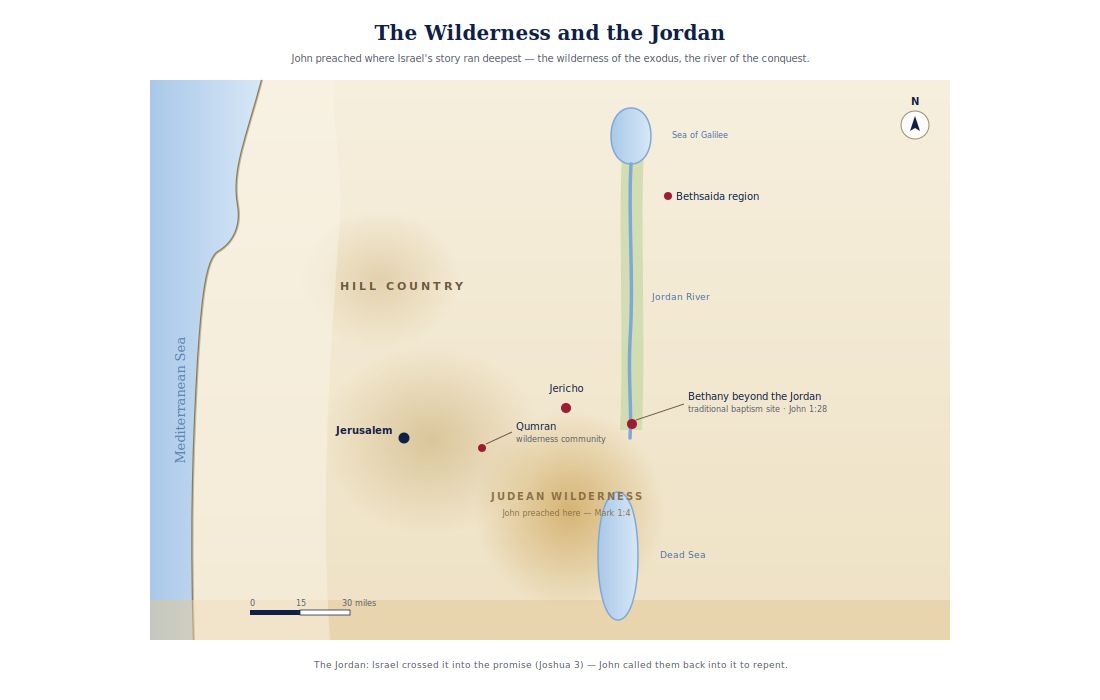
- Preaching in the wilderness — the barren Judean hills west of the Dead Sea — and baptizing in the Jordan River.
His message had two parts: repent (turn around — change direction, not just feel sorry), and be baptized as the outward sign of that turn, "for the remission of sins" (1:4).
Here's what made that explosive: Jews already knew all about ritual washings — archaeologists have uncovered stepped immersion pools (mikva'ot) all over first-century Judea, and groups like the Essenes bathed daily. 16 But those washings were repeated and self-administered. John's rite was a different animal: a once-for-all baptism, administered by another, in the Jordan, tied to repentance and the coming judgment. That combination had no precedent. Some point to Gentile proselyte baptism as the background — converts washed into the covenant — but clear evidence for that practice only appears in the late first century (around AD 80–90), after John's time, and Josephus's detailed account of King Izates's conversion to Judaism describes his circumcision at length but says nothing of baptism. 171816 Whatever John's exact model, his unspoken message to Jews — children of Abraham — was unmistakable: being born Jewish isn't enough anymore. You need to repent like a convert. No wonder "all the land of Judaea" went out to him (1:5) — and no wonder Jerusalem's religious establishment took notice (see John 1:19–24). The Jewish historian Josephus, writing around AD 93, also describes John as a "good man" who urged the Jews to be baptized — an outside witness that John was a real, public figure, not a legend. 19
"There cometh one mightier than I after me" (1:7). John points past himself with a striking image: "the latchet of whose shoes I am not worthy to stoop down and unloose." Untying sandals was a slave's job — and Jewish teachers taught that a disciple should do anything for his rabbi except untie his sandals; that was too degrading (Babylonian Talmud, Ketubot 96a). 2021 John says: compared to the Coming One, I'm not even worthy to be His slave. Then the promise: "He shall baptize you with the Holy Ghost" (1:8) — not just water on skin, but God's own Spirit poured into lives.
Scene 2: The baptism — heaven torn open (1:9–11)
Then Jesus arrives — from Nazareth of Galilee, a town so obscure that Nathanael would later sneer, "Can there any good thing come out of Nazareth?" (John 1:46). And He asks John to baptize Him.
Stop and feel the awkwardness. John resisted — Matthew tells us he said, "I have need to be baptized of thee, and comest thou to me?" (Matthew 3:14). A baptism "for the remission of sins," and the sinless Son of God steps into the water. Why?
Mark doesn't explain — he just shows it. But the reasons run deep (see Interpretation). What Mark does show is what happened next — and it's the most staggering thirteen-verse stretch in the Gospel:
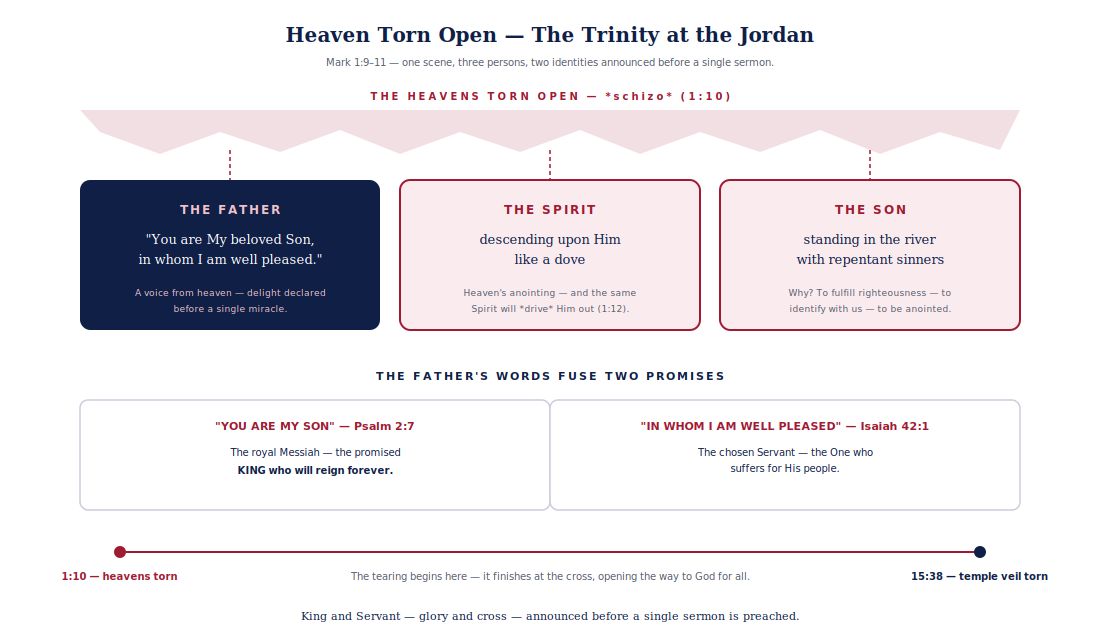
- The heavens were "parting" (1:10). The Greek word is schizo — torn, ripped open, like fabric. This isn't a gentle parting of clouds; it's the sky ripped like a curtain. Notice: Matthew and Luke, telling the same baptism, reach for the milder word "opened" — Mark alone chooses the violent one; he wants you to feel the rip. 2223 The word also answers Isaiah's old prayer: "Oh, that You would rend the heavens! That You would come down!" (Isaiah 64:1) — God is now doing exactly that. 24 (Mark uses schizo exactly twice: here, and when the temple veil tears at Jesus' death, 15:38. The tearing begins here and finishes at the cross.)
- The Spirit descended "like a dove" upon Him — heaven's anointing, visible and personal.
- A voice from heaven: "Thou art my beloved Son, in whom I am well pleased" (1:11).
All three persons of the Trinity, in one scene: the Son standing in the river, the Spirit descending, the Father speaking. And the Father's words fuse two Old Testament identities into one sentence:
| The Father says... | Echoing... | Which means... |
|---|---|---|
| "Thou art my Son" | Psalm 2:7 — "Thou art my Son" (the royal Messiah, the King) | Jesus is the promised King |
| "in whom I am well pleased" | Isaiah 42:1 — "My servant... in whom my soul delighteth" (the Suffering Servant) | Jesus is the Servant who will suffer 25 |
King and Servant. Glory and cross. Before Jesus preaches a single sermon, the Father announces the whole program: this Messiah reigns by serving, and wins by dying.
Scene 3: Driven into the wilderness (1:12–13)
"Immediately" — there's Mark's drumbeat — "the Spirit driveth him into the wilderness" (1:12).
Don't miss the verb. The Greek is ekballo — to throw out, to expel. It's the same word Mark uses for casting out demons (1:34, 39). 25 The Spirit doesn't gently lead Jesus into the desert; He hurls Him there. The beloved Son, fresh from the Father's delight, is thrown into a forty-day confrontation with Satan.
Mark gives us the shortest temptation account in the Bible — two verses where Matthew and Luke give a fuller account (Matthew 4:1–11; Luke 4:1–13). But every word is loaded:
- Forty days — Israel wandered forty years in the wilderness and failed; Elijah journeyed forty days to Horeb (1 Kings 19:8); Moses spent forty days on Sinai. Jesus relives the number — and where Israel failed, He will not.
- "With the wild beasts" — only Mark mentions this. In a world where wilderness meant danger, it's a note of real peril. But there's a whisper of something more: in Eden, Adam lived peaceably with the animals; the prophets dreamed of a day when "The wolf also shall dwell with the lamb" (Isaiah 11:6). Is Mark hinting that in Jesus, paradise is breaking back in? (See Fact/Inference/Disputed.)
- "The angels ministered unto him" — heaven never left Him alone. Tested by hell, attended by heaven.
Thirteen verses. Prophecy, repentance, Trinity, temptation. The overture is over — the Gospel has begun.
WORD STUDY
Baptize — baptizo (bap-TID-zo). To dip, plunge, immerse. John's hearers didn't need the word explained — it was ordinary Greek for dyeing cloth, dipping a cup into a bowl, or sinking a ship. 26 What shocked them wasn't the word but the who: Jews lining up for a one-time, administered washing of repentance — a combination with no precedent for insiders.
Wilderness — eremos (EH-reh-mos). Not an empty sandbox — the wild, uninhabited hill country: dangerous, demon-haunted in popular thought, and heavy with memory. 27 Israel was born in the wilderness (the exodus). The prophets said God would woo His people back there (Hosea 2:14). When John preaches in the eremos, every Jewish ear hears: God is starting over with us.
Torn open — schizo (SKHID-zo). Ripped, split apart — the word for tearing cloth. Mark uses it twice: here, the heavens torn at Jesus' baptism (1:10), and at the cross, the temple veil torn "from the top to the bottom" (15:38). The tearing begins with heaven opening over the Son and finishes with the way into God's presence ripped open for everyone. Mark's Gospel is bracketed by two tears.
"In Isaiah the prophet" — the quote that isn't (quite) Isaiah
Mark 1:2–3 weaves two prophecies together (the opening line also echoes Exodus 23:20):
- "Behold, I send my messenger before thy face, which shall prepare thy way before thee" — that's Malachi 3:1.
- "The voice of one crying in the wilderness, Prepare ye the way of the Lord, make his paths straight" — that's Isaiah 40:3.
So whose name goes on the quote? Here's where honesty matters. Your KJV reads "As it is written in the prophets" — but that follows the later Byzantine manuscripts. The earliest and most widespread witnesses — Sinaiticus, Vaticanus, Codex Bezae and others, across all the major manuscript families — read "in Isaiah the prophet." 28 That's why most modern translations (ESV, NIV, NASB, NET) print "in Isaiah the prophet."
Why do scholars consider the harder reading original? Picture a scribe copying "in Isaiah," then reading a quote that opens with Malachi — he'd feel the itch to fix it, and "in the prophets" solves the problem neatly. But no scribe would change the smooth "in the prophets" into the difficult "in Isaiah." The awkward reading is the one Mark most likely wrote. 28 (Ancient writers also cited a collection by its most prominent scroll — the way we might say "as Shakespeare says" when quoting a line from an anthology — so "Isaiah" can introduce a composite quote anchored by Isaiah 40:3.)
Either way, Mark's point stands: the forerunner was promised. John isn't a novelty — he's prophecy walking.
Why the sinless Son wades into a sinners' baptism
Mark never says why Jesus was baptized. The church has weighed it for 2,000 years, and the deepest answers converge:
- To fulfill all righteousness (Matthew 3:15) — Jesus does what God requires of His people, perfectly, even when He doesn't need to.
- To identify with sinners — the sinless One steps into the water with the repentant, previewing the cross where He'll stand for them. The baptism is His first act of solidarity with fallen humanity.
- To be anointed for ministry — the Spirit's descent and the Father's voice are a coronation and commissioning. Jesus' public ministry begins here, heaven-certified.
Notice what Mark doesn't do: he never suggests Jesus had sins to wash. The scandal of the scene is the point — the pure One plunges into the waters of repentance because He's plunging into our condition.
The Spirit who throws
Ekballo — the Spirit "drove" Him. Sit with the strangeness: the same Spirit who just descended like a dove now hurls the Son into danger. This is Mark's theology in a verb: God's love doesn't spare us from the wilderness — it sends us through it, and goes with us. The temptation isn't a detour from the mission; it's the first battle of it. And notice the order: beloved Son (1:11) comes before the testing (1:12–13). Identity before trial. The Father's delight is the armor Jesus wears into the wilderness.
The Christ Thread
Messianic promise — what points to the coming Messiah. Mark 1 is stitched to the Old Testament's promise line: the forerunner of Malachi 3:1 and Isaiah 40:3, the royal Son of Psalm 2:7, the Servant of Isaiah 42:1. Mark's claim is that every one of these threads lands on Jesus of Nazareth — the King who serves, the Servant who reigns.
OT/NT parallels — where the New Testament picks it up. Matthew, Luke, and John all tell this same opening (Matthew 3; Luke 3; John 1:19–34) — four witnesses, one beginning. John the Baptist's own summary: "Behold the Lamb of God, which taketh away the sin of the world!" (John 1:29). And Peter at Pentecost will announce that the Spirit John promised has now been poured out (Acts 2:33) — the promise of Mark 1:8, kept.
The Christian future — what this foreshadows for us. Your story runs the same pattern: repentance (the Jordan), washing (baptism), the Spirit's descent, the Father's "beloved" — and then the wilderness. The Christian life doesn't go from blessing to blessing; it goes from belovedness through testing, the way Jesus did. And the torn heaven of 1:10 previews the end: the day the sky tears open for good and the Son returns (Revelation 19:11).
Where in the Covenant Story?
Mark 1 stands at the hinge of the covenants. The old-covenant story — Abraham's family, Moses' law, David's throne — has run through 400 years of waiting. John's "baptism of repentance" is the prophetic sign that something new is breaking in: Isaiah's promised "new exodus" (Isaiah 40:3, quoted right here), where God Himself comes to rescue. Mark's opening phrase, "the beginning of the gospel," echoes Genesis 1:1 ("In the beginning") — a new creation is starting, and it starts with the arrival of the Son. We live on the far side of that hinge, under the New Covenant sealed in His blood (Mark 14:24).
Father, Son, and Spirit
Don't rush past 1:9–11 — it's one of the clearest Trinitarian moments in Scripture. The Son submits to baptism. The Spirit descends. The Father speaks. Three distinct persons, one divine action, no confusion between them. Everything the church would later confess about the Trinity — one God in three persons — is already happening here in the Jordan before it's ever defined in a creed. When you read "God" in this passage, train yourself to ask: which Person is acting, and what does that show me about Him?
WHAT THE CHURCH HAS ALWAYS BELIEVED: The early church saw Jesus' baptism as the Trinity's public unveiling. The Nicene Creed (A.D. 325) would later confess the Son as "begotten, not made" — the eternal Son, now standing in a human river.
It's Okay to Ask
Honest questions this passage raises — bring them, don't bury them:
- If Jesus was sinless, wasn't His baptism pointless? Or worse, misleading? (See "Why the sinless Son wades in" above — the church has wrestled with this for 2,000 years. You're in good company.)
- Why would the Spirit drive Jesus into temptation? Does God set us up? (The Spirit led Him into the battle, not into sin — and went with Him. See "The Spirit who throws.")
- Forty days of testing — did Jesus really suffer? (Yes — Hebrews 4:15: "tempted like as we are, yet without sin." Really tempted means really feeling it.)
Watch Out — the enemy is real
Mark names him plainly: Satan (1:13). Not a metaphor, not a bad mood — a personal, intelligent enemy who shows up at the very start of Jesus' ministry, right after the Father's delight. That's the pattern: the wilderness often follows the mountaintop. His aim is always the same — to divert the Son from the Father's will (he'll try again through Peter in 8:33, and in Gethsemane). For us: expect testing after blessing, know the Word is the weapon (Jesus answers Satan with Scripture in Matthew's account), and remember the angels ministered. You are never in the wilderness alone.
FACT, INFERENCE, OR DISPUTED?
- FACT: Mark 1:2–3 combines Malachi 3:1 (with an echo of Exodus 23:20) and Isaiah 40:3. The earliest and most widespread manuscripts read "in Isaiah the prophet"; the KJV follows the later Byzantine reading "in the prophets." The meaning is untouched either way.
- FACT: Schizo ("torn") appears in Mark at 1:10 (heavens) and 15:38 (temple veil) — and nowhere else.
- INFERENCE: Mark intends the two "tearings" to echo each other — heaven opened over the Son; the way to God opened for all.
- INFERENCE: "With the wild beasts" (only Mark mentions them) is genuinely open: (1) real peril — the Judean wilderness held boars, jackals, wolves, leopards, and hyenas; 22 (2) Eden restored — the Messiah at peace with the animals, as in Isaiah 11:6; 29 (3) the beasts as part of the hostile wilderness, alongside Satan — demons were thought to haunt desolate places (Isaiah 13:21; 34:14); 3031 (4) a whisper of Psalm 91:13 ("Thou shalt tread upon the lion and adder") — the angels' protection already at work. Mark doesn't choose one; neither should we.
- DISPUTED: Whether John had contact with the Qumran community (the Essenes lived in this same wilderness). Intriguing, unprovable — and unnecessary for the lesson.
SCHOLAR'S NOTE: The Jordan wasn't just water — it was memory. Israel crossed it to enter the promised land (Joshua 3–4); Elijah parted it before being taken up (2 Kings 2). When crowds waded into the Jordan with John, they were reenacting the conquest: leaving the old life on one bank, rising to a new one on the other. And when Jesus comes up out of that same river with heaven torn open above Him, Mark is whispering: the true conquest has begun.
Cross-references (explained, not just listed)
- Malachi 3:1 + Isaiah 40:3 — the two strands of Mark 1:2–3: a messenger promised, a voice in the wilderness.
- 2 Kings 1:8 — Elijah's wardrobe ("A hairy man wearing a leather belt around his waist"); John's dress is a walking prophecy.
- Psalm 2:7 + Isaiah 42:1 — the two scriptures fused in the Father's voice: the royal Son and the suffering Servant, one person.
- Matthew 3:13–17; Luke 3:21–22; John 1:29–34 — the other Gospels' fuller accounts; John the Baptist's own testimony ("Behold the Lamb of God, which taketh away the sin of the world!").
- 1 Kings 19:8 — Elijah's forty-day journey; the number forty as Israel's testing number.
Go Deeper
Hungry for more? Two doors worth opening:
- Read Matthew 3:13–4:11 and Luke 3:21–4:13 alongside Mark 1:9–13 — the same events with the detail Mark sprints past (including the actual temptations).
- Isaiah 40 — the whole chapter Mark quotes from. Read it the way Israel heard it: exiles daring to hope again.
Theological truth (arising from the text)
God keeps His promises down to the wardrobe details — and His Messiah is announced not with fanfare but with repentance. The Trinity acts together at the Jordan: the Father speaks delight, the Spirit descends, the Son submits. And belovedness comes before battle: God names us before He tests us.
Humble — and confident
Humble, because John — the greatest prophet of the old age, Jesus said — considered himself unworthy to untie the Coming One's sandals. If he took the low place, how much more should we? Repentance isn't a one-time gate; it's the posture of the whole Christian life.
Confident, because the Father's voice over Jesus echoes over every believer: beloved, in whom I am well pleased — not because of our performance, but because we are in the Beloved (Ephesians 1:6). Identity before trial. Delight before duty.
Confess It
John's call hasn't expired: repentance is the posture of the whole Christian life, not just its doorway. Before you move on, name one thing concretely — not "my sins" in general, one specific turn you've been avoiding — and confess it to God now (1 John 1:9). If it involves another person, decide today what making it right looks like.
For discussion
- John baptized Jews as if they were Gentile converts. What "I'm already fine" assumptions might God be challenging in us?
- The Father spoke delight over Jesus before He'd done any ministry. How does "beloved first, tested second" change the way you face your own wilderness?
- Mark's Spirit drives Jesus into difficulty, not away from it. When has a hard season turned out to be Spirit-led?
What He has done (the indicative)
Before one "you should," hear what He did: the Father kept a 400-year-old promise down to the wardrobe details. The Son stepped into sinners' water. The Spirit tore heaven open — then walked Jesus into the wilderness with Him. Belovedness came before battle; delight before duty. Every step below is a response to that, not a way to earn it.
This week's practices
- Repentance inventory. Set aside 20 unhurried minutes. Ask the Holy Spirit to show you one direction you've been walking that needs reversing — not vague guilt, one concrete turn. Name it, confess it, turn.
- Remember your baptism (or consider it). If you've been baptized, revisit the day — what did it mean? If you haven't and you're a believer, talk to a pastor or trusted believer this week about why.
- Pray It Back. Take Mark 1:11 into prayer each morning: "Father, You called Jesus beloved before He'd done anything. Call that over me today. Show me where I'm trying to earn what You've already given."
- Memorize Mark 1:11. The Father's word to the Son — and, in Him, to you: "Thou art my beloved Son, in whom I am well pleased."
For Us Together
Ask your small group, your family, or one friend this week: "Where is the Spirit driving us into the wilderness — and how do we go together instead of alone?" Wilderness is survivable in company; it's crushing in isolation.
Who Needs This?
Who in your life is standing at their own Jordan — needing to hear "turn around," or needing to hear "beloved"? One name. One conversation, one text, or one prayer for them this week.
Take It Home
At the table or at bedtime, ask your kids: "John said he wasn't worthy to untie Jesus' sandals — a slave's job. What job would be too low for you to do for a king? John said Jesus is so great that even the lowest job was too high for him." Let them feel how big Jesus is.
Praise Him
Don't end with a to-do list — end with worship. Right now, out loud or in writing, finish this sentence: "Father, I praise You because in this passage I saw that You _____." (Belovedness before battle? A 400-year promise kept? A heaven that tears open?) Sit in it for a minute. Theology that doesn't become doxology hasn't finished its work.
The bottom line
The Gospel begins with a call to turn (John), a Son who plunges into our waters (Jesus), and a heaven ripped open in delight (the Father and the Spirit). Before the first miracle, Mark has shown us the pattern of the whole Christian life: repent, be washed, hear "beloved" — then follow the Spirit, even into the wilderness.