
Before You Read: Open My Eyes
Before you read a single verse, pray this — out loud if you can:
"Father, the disciples asked 'What manner of man is this?' — and I'm asking it too. Show me Your Son's authority over every storm, every shadow, every grave. And when I'm afraid, teach me 'only believe.' In Jesus' name, amen."
(Psalm 119:18 — "Open thou mine eyes, that I may behold wondrous things out of thy law.")
Welcome
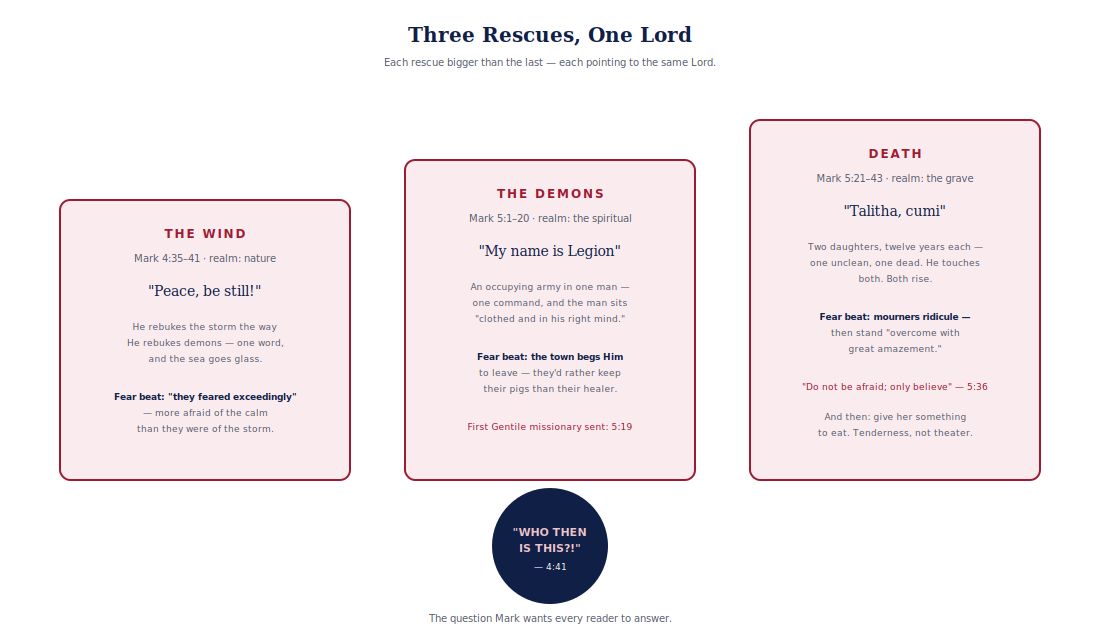
The teaching is over. The crowds go home. And Mark takes us onto dark water — where, in a single night and the day that follows, Jesus will face a storm, a graveyard, and a funeral. Three rescues. Three realms no one else can touch: wind, demons, death.
If Lesson 05 asked "What is the kingdom of God like?", this lesson asks the louder question: "What manner of man is this?!" (4:41). By the end, you'll know.
CHECK WHAT YOU THINK YOU KNOW
- ☐ "Jesus calmed the storm to prove He was God." (Partly — but notice what He asks the disciples instead.)
- ☐ "The demons called 'Legion' were a Roman army haunting the man." (No — see "What is thy name?")
- ☐ "Jesus sent the demons into the pigs to destroy someone's livestock." (He didn't send them — see "The question about the pigs.")
- ☐ "Jairus' daughter and the bleeding woman are two unrelated stories." (Mark weaves them together on purpose.)
Where we are in the story
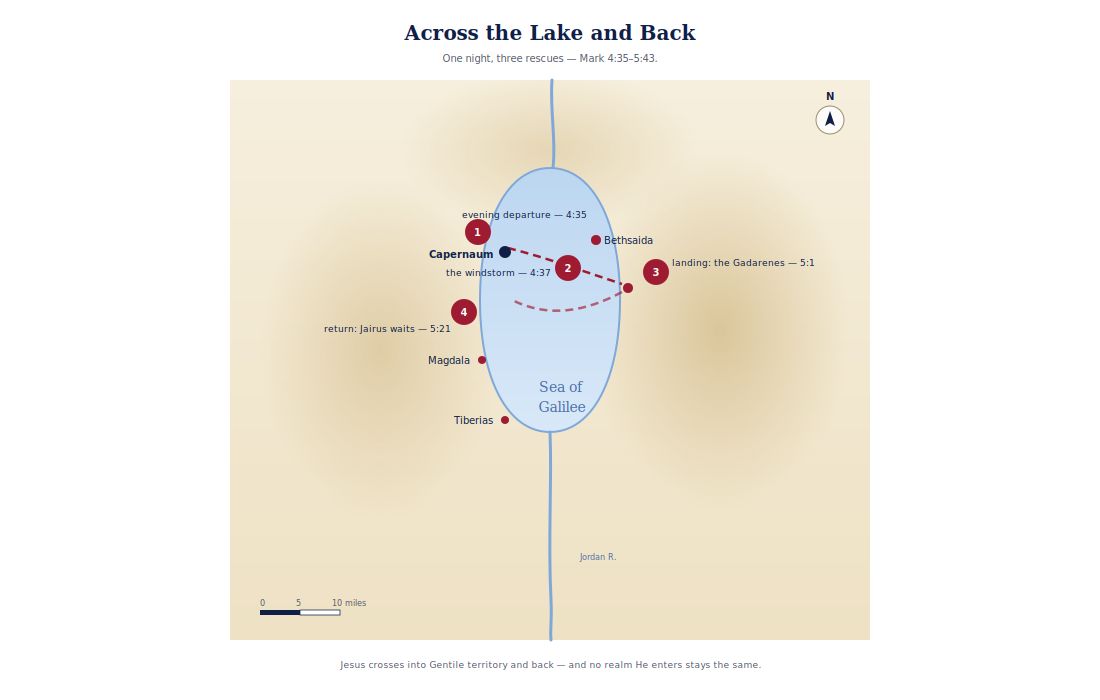
It's evening after the parables day (4:35). Jesus has been teaching the crowds from a boat; now He says to His disciples, "Let us go over to the Philistines' garrison, that is on the other side." The "other side" of the Sea of Galilee is Gentile territory — the Decapolis region. Jesus is taking Jewish fishermen into the land of pagans, tombs, and pigs. Nobody in the boat knows what's coming.
Scene 1: "Peace, be still!" (4:35–41)
They leave the crowd and take Jesus "as He was" — exhausted, still in the boat He taught from. Other little boats follow. Then the lake does what it does: the Sea of Galilee sits 700 feet below sea level, ringed by hills, and cold air can drop through the ravines and explode into violent, sudden squalls. "A great storm of wind, and the waves beat into the ship, so that it was now full" (4:37).
And Jesus? In the stern, asleep on a pillow (4:38). Several of these men are professional fishermen — if they're terrified, this is no ordinary squall. They wake Him with an accusation that still stings: "Master, carest thou not that we perish?"
What happens next takes one verse: "And he arose, and rebuked the wind, and said unto the sea, 'Peace, be still!' And the wind ceased, and there was a great calm" (4:39).
Don't miss the word rebuked (epitimao). It's the same word Jesus uses on demons (1:25). He doesn't pray about the storm. He doesn't ask the Father to handle it. He commands it — the way you'd command a person. The sea obeys like a servant.
Then He turns the question back on them: "Why are ye so fearful? how is it that ye have no faith?" (4:40). And Mark records their reaction with devastating honesty: "they feared exceedingly, and said one to another, What manner of man is this, that even the wind and the sea obey him" (4:41).
Read that twice. They were afraid of the storm. Now they're more afraid of the calm — because a man just did what only God does. (Psalm 89:9: "Thou rulest the raging of the sea: when the waves thereof arise, thou stillest them." Psalm 107:29: "He maketh the storm a calm, so that the waves thereof are still.") The disciples have read those psalms in synagogue all their lives. Now they're watching one come true in their boat.
Scene 2: The man no one could tame (5:1–20)
They land "in the country of the Gadarenes" (5:1) — Gentile territory on the lake's eastern shore. (Pigs on the hillside are the giveaway: no Jewish farmer would raise them.) Out of the tombs comes a man with an unclean spirit — and Mark paints him in unforgettable strokes:
- No one could bind him — not even with chains; he tore them apart (5:3–4).
- Night and day he lived among the tombs and in the mountains, crying out and cutting himself with stones (5:5).
- He sees Jesus "from afar," runs to Him — and worships Him (5:6). (Proskyneo — the word for bowing before a king. Even in ruins, something in him knows who this is.)
Then the voice that isn't his: "What have I to do with thee, Jesus, thou Son of the most high God? I adjure thee by God, that thou torment me not" (5:7). Jesus commands, "Come out of the man, unclean spirit!" — and asks the strangest question in the Gospels: "What is thy name?" (5:9).
"My name is Legion: for we are many."
Legion (legeon) is a Latin military word — a Roman legion was about 6,000 soldiers. 61249 This isn't one demon with a dramatic name; it's an occupying army in a single human soul. (And the military echo would not be lost on readers living under Rome: the man's condition looks like an occupation.)
The demons beg — twice. First, not to be sent "out of the country" (5:10); then, seeing a herd of about 2,000 swine feeding nearby, to be sent into the pigs (5:12). "And forthwith Jesus gave them leave" (5:13). The herd stampedes down the steep bank into the sea and drowns.
The question about the pigs. Did Jesus destroy someone's livelihood? Read carefully: Jesus didn't send the demons into the pigs — He permitted what they begged for. 9 And what happened next is the point Mark wants: given an inch, evil self-destructs. Two thousand pigs rushing to their death in minutes is a parable of what the demons were doing to the man slowly — and what they do to every soul they hold. As for the owners' loss: Mark never mentions compensation, because Mark's math is different — one restored human being outweighs any herd. (The townspeople, notably, do the opposite math — see below.)
The herdsmen run and tell it everywhere. The town comes out — and finds the man "sitting, and clothed, and in his right mind" (5:15). Three words that undo everything Mark told us: the runner now sits; the wild man is clothed; the madman is in his right mind. And the crowd's response? "They were afraid" — and "began to pray him to depart out of their coasts" (5:15, 17).
Let that sink in. They'd lived with a screaming demoniac in their graveyard for years. A man is healed before their eyes — and they're more frightened of the Healer than they were of the horror. Fear of Jesus can look like indifference, but here it looks like economics: 2,000 pigs are floating in the lake, and they'd rather have their herd than their healer.
But the healed man begs to go with Jesus — and Jesus gives him a different mission: "Go home to thy friends, and tell them how great things the Lord hath done for thee, and hath had compassion on thee" (5:19). Notice: to Jews Jesus says "tell no one" (the Messianic Secret); to this Gentile He says "go tell everyone." In Gentile territory there's no false-Messiah confusion to manage — so this man becomes the first missionary to the Gentiles in Mark's Gospel, proclaiming throughout the Decapolis (the "Ten Cities," a league of Gentile cities east of the lake). 62 "And all marvelled" (5:20).
Scene 3: Two daughters, one Lord (5:21–43)
Back across the lake, a great multitude waits. Out of it steps Jairus, "one of the rulers of the synagogue" (5:22) — a respected religious leader, the kind of man who manages the synagogue — and he falls at the feet of the very man the religious establishment is already turning against. He falls at Jesus' feet: "My little daughter lieth at the point of death: I pray thee, come and lay thy hands on her, that she may be healed; and she shall live" (5:23).
Jesus goes. The crowd presses. And Mark slows the story to a crawl — because he's about to tell two stories at once, nested like Russian dolls:
The woman (5:25–34): Twelve years with "an issue of blood" — a chronic hemorrhage that, under Leviticus 15, made her ritually unclean: everything she touched, everyone who touched her. Twelve years of isolation, of being the untouchable. She'd "suffered many things of many physicians" and "spent all that she had" — broke and worse than ever (5:26). Mark's bluntness about the doctors is almost funny until you feel her desperation.
She comes up behind Jesus in the crowd: "If I may touch but his clothes, I shall be whole." (5:28). She touches — and "immediately" the flow stops; she feels in her body that she's healed (5:29).
Then the strangest moment: Jesus, "knowing in himself that virtue had gone out of him," turns: "Who touched my clothes" (5:30). The disciples are incredulous — "Thou seest the multitude thronging thee, and sayest thou, Who touched me?" But Jesus isn't asking for information. He's asking for her — He won't let her steal a miracle and disappear. Trembling, she falls down and tells Him "the whole truth" (5:33).
And He calls her something no one has called her in twelve years — not "unclean," not "patient," but: "Daughter, thy faith hath made thee whole; go in peace, and be whole of thy plague" (5:34). Daughter. In one word, Jesus gives her back a family, a community, a name.
The child (5:35–43): While He's still speaking, word comes from Jairus' house: "Thy daughter is dead: why troublest thou the Master any further?" (5:35). The mourners are already wailing — professional mourners, flutes, chaos.
Jesus' response is six words that carry the whole Gospel: "Be not afraid, only believe" (5:36).
He takes only Peter, James, and John — the inner three — plus the parents, puts the mockers out ("they ridiculed Him," 5:40), and enters the room. He takes the dead girl's hand — touching a corpse, which made a person unclean under the law, just as touching the leper did in 1:41 — and speaks in her own language, Aramaic: "Talitha, cumi," which Mark translates for his Roman readers: "Damsel, I say unto thee, arise" (5:41).
"And straightway the damsel arose, and walked; for she was of the age of twelve years. And they were astonished with a great astonishment" (5:42). Then, with devastating tenderness: He tells them to give her something to eat (5:43). The Lord of death's first order of business? Lunch. She's a hungry twelve-year-old again — not a theological exhibit.
Why the nesting? Mark sandwiches the woman's story inside Jairus' on purpose — the two "daughters" mirror each other: one has suffered twelve years; the other is twelve years old. One is unclean by disease, one is dead — the two conditions no rabbi could touch. Jesus touches both. And both are somebody's "daughter" — one named so by Jesus, one mourned so by her father. Mark is showing you, twice over: there is no condition — sickness, shame, death itself — that puts you beyond His reach.
WORD STUDY
Rebuked — epitimao (eh-pee-tee-MAH-oh). To rebuke, censure, command with authority. 63 Jesus epitimaos the wind (4:39) exactly as He epitimaos demons (1:25, 3:12). And His two words to the sea carry the same flavor: "Peace!" (siopa — be silent, hush) and "Be still!" (pephimoso — literally "be muzzled," the same root as the "be silent!" He speaks to the demon in 1:25). 6465 Mark's vocabulary quietly insists: the storm and the spirits answer to the same voice.
Legion — legeon (leh-geh-OHN). A Latin loanword: a Roman legion at full strength numbered roughly 6,000 soldiers. The demons name themselves an occupying army — and every reader under Roman occupation feels the double meaning. One man held by a legion; one word frees him.
Worshiped — proskyneo (pross-koo-NEH-oh). To bow down, prostrate oneself before a superior — the word for worshiping a king or a god. 9 The ruined man of the tombs proskyneos Jesus (5:6) before any disciple fully does. Broken people often see clearly first.
Talitha, cumi — Aramaic, preserved word-for-word by Mark (who then translates for his Greek readers): "Little girl, I say to you, arise." Mark keeps Jesus' Aramaic — always with a translation — at the moments that burned into memory: Talitha, cumi (5:41), Ephphatha (7:34), Abba (14:36), Eloi, Eloi, lama sabachthani (15:34) — as if Peter remembered the sound of His voice and Mark couldn't bear to lose it. 66
"Do You not care?" — the accusation in the boat
The disciples' cry is the most honest prayer in Mark: "Master, carest thou not that we perish?" (4:38). Notice Jesus doesn't scold the fear — He questions the faithlessness: "Why are ye so fearful? how is it that ye have no faith?" (4:40). The issue isn't that they woke Him; it's that they assumed His sleep meant His indifference. A sleeping Savior is not an absent one. Mark wants storm-tossed readers — in Rome, under Nero, and in every age since — to hear that.
Why ask a demon its name?
In the ancient world, knowing a spirit's name was thought to give power over it. But Jesus doesn't need the name — He already commanded it out (5:8). So why ask? Because the answer exposes the scale of the ruin: not one squatter but an army. The question isn't for Jesus' information; it's for ours — and for the man's. Naming the darkness is often the first step out of it.
The townspeople's terrible math
"They began to pray him to depart" (5:17). Sit with this: a man clothed and in his right mind sits before them, and they choose the pigs. It's easy to judge — until you ask what your 2,000 pigs are. What loss would make Jesus feel too expensive? A habit, a relationship, a revenue stream, a reputation? The Gadarenes aren't villains; they're a mirror.
The sandwich: why Mark nests the stories
Mark's "sandwich" technique (he does it in 3:20–35 and 11:12–25 too): start story A, interrupt with story B, return to finish A. 67 The interruption interprets the outer story. Here: Jairus' desperate interruption-delay ("while He was still speaking, your daughter is dead") becomes the very stage for the lesson — delays are not denials. The woman's twelve years of suffering and the girl's twelve years of life interlock to say: whether you've suffered long or died young, His touch reaches you. And "only believe" (5:36), spoken to a grieving father, is Mark's gospel to every reader holding a dead hope.
The Christ Thread
Messianic promise — Christ in His own story. "What manner of man is this?!" (4:41) is the chapter's thesis question, and Mark's answer is Yahweh's résumé: only God stills the sea (Psalm 89:9; 107:29), only God commands the spirits, only God reverses death. The storm-stilling, the binding of Legion, the "Talitha, cumi" — each is a Messianic credential, the promised King exercising the Creator's own prerogatives in a fishing boat.
OT/NT parallels — where the New Testament picks it up. Elisha raised the Shunammite's son slowly, laboriously, face-to-mouth (2 Kings 4:32–37); Jesus raises Jairus' daughter with two words. John 11 replays this chapter's logic on a grander stage — delay as the stage, "only believe" as the word, a dead one walking out. And the Gerasene demoniac, sent to "tell them how great things the Lord hath done" (5:19), is the advance guard of the Gentile mission that fills the book of Acts.
The Christian future — what this foreshadows for us. The girl who sat up is a preview, not an exception: "the dead shall be raised" (1 Corinthians 15:52), and her story is a trailer for it. The "great calm" (4:39) foreshadows the new creation's peace — no more chaos-sea (Revelation 21:1), no more tears (21:4). Every storm He stills now is a rehearsal for the world without storms.
Where in the Covenant Story?
The New Covenant is breaking in with creation-level power. Jesus stilling the sea reenacts Genesis 1 — God subduing the chaotic waters, now in a boat off Capernaum. And the Abrahamic promise ("all nations blessed") takes its first visible step beyond Israel: the first missionary Jesus commissions in Mark is a Gentile (5:19–20), sent to the Decapolis. The covenant that began with one family's blessing is already spilling over its banks.
Father, Son, and Spirit
The Son commands wind, demons, and death — and sleeps, weeps with mourners, and takes a girl by the hand. Fully God, fully man, in one chapter. The Father's compassion flows through Him: "tell them... how great things the Lord hath done for thee, and hath had compassion on thee" (5:19) — "the Lord" who showed compassion is Jesus, identified with Yahweh's own mercy. And the Spirit's power is present in every deliverance — the same Spirit who descended at the Jordan now drives back the darkness, one tomb at a time.
WHAT THE CHURCH HAS ALWAYS BELIEVED: The Council of Chalcedon (A.D. 451) confessed Christ as "truly God and truly man" — two natures, one person. 68 Mark 4–5 is Chalcedon in narrative: the man asleep on the pillow is the God who rebukes the sea. If He weren't man, He couldn't touch the girl's hand; if He weren't God, the wind wouldn't have listened.
It's Okay to Ask
Honest questions this passage raises — bring them, don't bury them:
- Why did Jesus let the pigs die? Didn't their owners suffer? (Read 5:13 carefully: He permitted what the demons begged for; He didn't send them. And Mark's math is deliberate — one restored human being outweighs any herd. The townspeople did the opposite math.)
- Why did Jesus ask "Who touched Me?" — didn't He know? (He wasn't gathering information; He was drawing her out. He wouldn't let her steal a miracle and disappear — He wanted to call her "Daughter" to her face.)
- If Jesus can raise the dead, why doesn't He always? (The girl's raising is a preview, not the pattern — yet. Death still happens because the final resurrection hasn't. "Talitha, cumi" is a trailer, not the feature. The feature is coming.)
Watch Out — the enemy is real, organized, and leashed
"My name is Legion" (5:9) — the enemy isn't a vague force; he's personal, intelligent, and organized (a legion is an army). Notice two things: the demons beg — twice (5:10, 5:12). They cannot act without permission. And notice what they beg for: not to be tormented, a different zip code, a herd of pigs. Evil is real, but it is not sovereign — it operates on a leash held by Christ. For us: don't deny the darkness (the tombs are real), don't fear it either (the leash is real too). And watch the townspeople — fear of Jesus can look like economics. The enemy's quietest victory is making the Healer feel too expensive.
FACT, INFERENCE, OR DISPUTED?
- FACT: Epitimao ("rebuked") is used of both the wind (4:39) and demons (1:25). INFERENCE: Mark intends the parallel — the same authority that stills storms silences spirits.
- FACT: About 2,000 swine drowned (5:13); the healed man was found "sitting, and clothed, and in his right mind" (5:15).
- INFERENCE: Jesus permitted rather than sent the demons into the pigs (5:13, "He gave them leave") — the destruction reveals evil's nature, not Christ's cruelty.
- INFERENCE: Mark's nesting of the two "twelve-year" stories is deliberate literary design, not coincidence.
- DISPUTED: The exact location of "the country of the Gadarenes" — most later manuscripts read "Gadarenes" (which the KJV follows); some of the oldest read "Gerasenes" (followed by the NIV and ESV); others read "Gergesenes," likely from Origen, who knew a lakeside village called Gergesa — modern Kursi, where a steep bank runs straight into the water. 2869 Gadara itself sat several miles inland, but its territory reached the lake. 28 The region — Gentile territory east of the lake — is certain; the precise town spelling is the dispute.
SCHOLAR'S NOTE: The Decapolis ("Ten Cities") was a league of predominantly Gentile cities southeast of the lake — Greek in culture, Roman in loyalty, granted municipal freedom under Rome after Pompey's 64–63 B.C. settlement. (Ancient lists of the ten cities vary — Pliny names ten, Ptolemy eighteen — so no single list is fixed.) 447040 Everything about 5:1–20 screams Gentile territory: tombs (Jews avoided corpse-impurity), pigs (unclean animals), and a herd of 2,000 (commercial-scale farming). Mark is showing that Jesus' authority doesn't stop at the Jewish border — the first missionary He commissions in this Gospel is a Gentile (5:19–20).
Cross-references (explained, not just listed)
- Psalm 89:9; Psalm 107:28–30 — only God stills the sea; the disciples' psalm-singing background makes 4:41 explosive.
- Leviticus 15:25–27 — the woman's twelve-year uncleanness: her condition isolated her from worship and touch.
- 2 Kings 4:32–37 — Elisha raises the Shunammite's son; the Old Testament's great resuscitation story — and Elisha's is slow, labored, repeated. Jesus speaks twice.
- John 11 — Lazarus: the other great "only believe" story, where delay is also the stage.
Go Deeper
Hungry for more? Two doors worth opening:
- John 11 — Lazarus: the full-length version of this chapter's logic — delay, "only believe," a dead man walking out.
- Psalm 107:23–32 — the storm psalm the disciples grew up singing. Read it, then read Mark 4:35–41 again and feel what they felt.
Theological truth (arising from the text)
Jesus' authority is not limited by realm (wind, demons, death), by religion (Jew or Gentile), or by ritual (the untouchable, the corpse). And His power is never cold: He rebukes the storm but takes the girl by the hand; He permits the demons' destruction but calls the woman "Daughter." Authority with tenderness — that is what "Lord" means in Mark.
Humble — and confident
Humble, because the disciples — who had seen the miracles of chapter 1 — still panicked in the boat. Proximity to Jesus doesn't automatically produce faith in the storm. If they cried "Don't You care?", we can bring Him our own unfiltered fear without shame.
Confident, because there is no storm He sleeps through indifferently, no tomb He can't enter, no "dead too long" He can't reverse. The Gadarenes begged Him to leave; the healed man begged to follow. Every one of us is making one of those two choices.
Confess It
The townspeople's math — pigs over Healer — is uncomfortably familiar. Name your "2,000 pigs": the loss, habit, or comfort that would make Jesus feel too expensive. Confess the economics honestly (1 John 1:9): "Lord, I've been doing the Gadarenes' math. Forgive me — and be worth more to me than _____."
For discussion
- The disciples moved from fear of the storm to fear of the Savior ("they feared exceedingly"). When has getting closer to Jesus actually made Him feel bigger — and scarier — to you?
- The townspeople chose their pigs over their healer. What's your "2,000 pigs" — the loss that would make Jesus feel too expensive?
- "Be not afraid, only believe" was spoken to a father holding a dead hope. What dead hope do you need to hear those six words over?
What He has done (the indicative)
Before one "you should," hear what He did: He crossed a lake at night for one ruined man in a graveyard. He touched the untouchable woman and called her "Daughter." He took a dead girl's hand and spoke her awake — then ordered lunch, because she's twelve, not a theological exhibit. Wind, demons, death: all answered to Him. And He did it all before asking anything of you. Every step below is a response to that Lord — not a way to earn Him.
This week's practices
- Name the storm. Write down the one situation currently making you cry "Don't You care?" Pray the disciples' honest prayer — then write Jesus' answer from 4:39–40 underneath it. Read both daily.
- The "Daughter" exercise. Where do you feel labeled — by failure, by shame, by a condition? Write the label, then write over it what Jesus called the woman: Daughter / Son — your faith has made you well.
- Tell like the Gerasene. He couldn't go with Jesus, so he told his town. Tell one person this week one specific "great thing the Lord has done for you" — no sermon, just the story.
- Pray It Back. Take Mark 5:36 into prayer each morning: "Lord, over my dead hope — my ____ — speak Your six words: 'Do not be afraid; only believe.' I believe; help my unbelief."
- Memorize Mark 5:36. Six words for dead hopes: "Be not afraid, only believe."
For Us Together
Ask your small group this week: "What storms are we in together — and are we crying 'Don't You care?' at each other, or waking Jesus together?" The boat held twelve panicking disciples and one sleeping Savior; the math still works. Pray one another's storms out loud.
Who Needs This?
Who in your life is living among the tombs — isolated, self-harming, beyond what polite company can fix? One name. Jesus crossed a lake for one such person. Cross your street, your office, your comfort zone for yours.
Take It Home
At bedtime, tell your kids the "Talitha, cumi" story — and tell them Mark remembered the exact words, in Jesus' own language, like Peter couldn't forget the sound of His voice. Then ask: "Jesus spoke to a dead girl and she woke up. What do you think His voice sounded like?" Let wonder do the teaching.
Praise Him
Don't end with a to-do list — end with worship. Right now, out loud or in writing, finish this sentence: "Father, I praise You because in this passage I saw that You _____." (Command the wind? Call the untouchable "Daughter"? Hold the leash on Legion?) Sit in it for a minute. Theology that doesn't become doxology hasn't finished its work.
The bottom line
Wind obeys Him. Demons beg Him. Death reverses at His touch. Mark 4:35–5:43 is the Gospel's loudest answer to its own question — "What manner of man is this?!" — and its tenderest: the Lord of the storm takes dead girls by the hand and makes sure they get lunch.