
Before You Read: Open My Eyes
Before you read a single verse, pray this — out loud if you can:
"Father, Your Spirit breathed out these words. Before I read about Nazareth's unbelief and Herod's violence, open my eyes to where I do the same — the familiarity that stops expecting, the conviction I enjoy but never obey. Don't let me read this as their story. Make it mine. In Jesus' name, amen."
(Psalm 119:18 — "Open thou mine eyes, that I may behold wondrous things out of thy law.")
Welcome
Two prophets. Two rejections. In Nazareth, the hometown crowd who watched Jesus grow up decides they know Him too well to believe Him. In a palace prison, the greatest prophet of the old age loses his head for telling the truth about a king's marriage.
Mark places these stories side by side on purpose: this is what happens when the kingdom collides with human hearts — familiarity breeds unbelief, and power breeds violence. And yet the mission doesn't stop. Between the two rejections, Jesus sends out the Twelve — and the kingdom advances anyway.
CHECK WHAT YOU THINK YOU KNOW
- ☐ "Jesus couldn't do miracles in Nazareth because the people sapped His power." (Not how Mark tells it.)
- ☐ "John the Baptist was executed for preaching against the government." (It was more personal — and more sordid — than that.)
- ☐ "Herod wanted John dead from the start." (Actually, Herod protected him — until one night changed everything.)
- ☐ "Salome's dance was the scandal of the story." (The dance isn't the scandal. What it purchased is.)
Where we are in the story
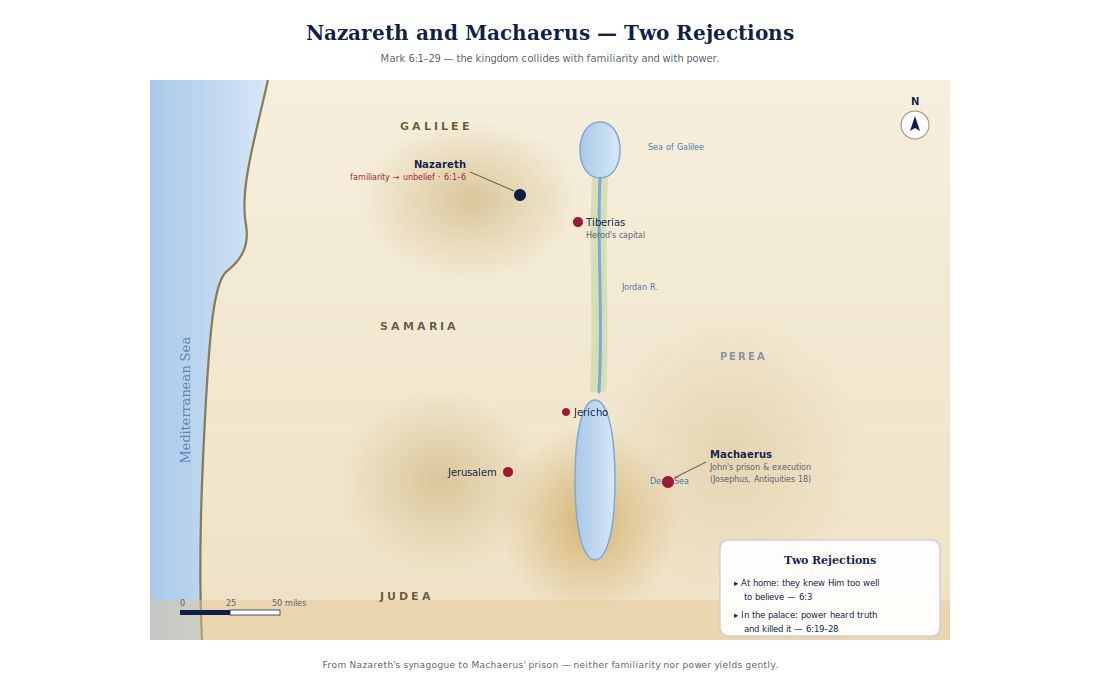
Jesus leaves Capernaum and comes "to his own country" (6:1) — Nazareth, the Galilean hill town where He grew up. The disciples come with Him. It's Sabbath. He teaches in the synagogue. And everything goes wrong.
Scene 1: The prophet without honor (6:1–6)
At first, the reaction sounds positive: "many hearing him were astonished, saying, From whence hath this man these things? and what wisdom is this which is given unto him, that even such mighty works are wrought by his hands" (6:2).
Then the turn — and it's all about familiarity: "Is not this the carpenter, the son of Mary, the brother of James, and Joses, and of Juda, and Simon? and are not his sisters here with us?" (6:3).
Read their logic: We know this guy. We watched Him grow up. We know His mother, His brothers, His sisters. Carpenters don't talk like this. The Greek word is tekton — craftsman, builder, working with wood and stone. There's no scorn in the trade itself; the scorn is in the ceiling they've put over Him: someone so ordinary can't be someone so extraordinary.
"They were offended at him" (6:3). The word is skandalizomai — they stumbled over Him; He became a stumbling block. Not anger, exactly — an offended refusal to believe.
Jesus answers with a proverb: "A prophet is not without honour, but in his own country, and among his own kin, and in his own house" (6:4). Three narrowing circles — country, relatives, house — and the rejection gets closer with each one. The people who should know Him best know Him least.
Then Mark's most startling sentence in the chapter: "He could there do no mighty work, save that he laid his hands upon a few sick folk, and healed them" (6:5).
Could do no mighty work. Not would not. Sit with that. It doesn't mean Nazareth drained His power like a battery — Jesus' power isn't a finite resource. It means something deeper about how His power works: He does not force Himself on unbelief. Mighty works in Mark are signs that invite faith; where faith is refused as a matter of principle, the signs stop — not because He's weak, but because He's not a circus act. (Notice He still heals "a few sick folk" — compassion doesn't shut down entirely; but the mighty works that reveal the kingdom do.)
"And he marvelled because of their unbelief" (6:6). Only twice in the Gospels does Jesus "marvel": here at unbelief, and at the centurion's faith (Matthew 8:10; Luke 7:9). 71 Unbelief is as astonishing to Him as faith is.
Scene 2: The Twelve sent out (6:7–13)
Between the two rejections, the mission expands. Jesus "called unto him the twelve, and began to send them forth by two and two; and gave them power over unclean spirits" (6:7).
Two by two — for mutual support, for credible witness (Deuteronomy 19:15 required two witnesses), and because the kingdom is a shared work from the start.
Their packing list is a sermon in itself: "take nothing for their journey, save a staff only; no scrip, no bread, no money in their purse: but be shod with sandals; and not put on two coats" (6:8–9). In other words: travel light, trust God, depend on hospitality. The mission runs on God's provision, not their preparation. (Matthew's version even forbids the staff — the details vary; the principle doesn't: go lean, go trusting.)
Instructions for reception and rejection: stay in one house per town (no shopping for better lodgings — don't be a burden), and "not receive you, nor hear you, when ye depart thence, shake off the dust under your feet for a testimony against them" (6:11). Shaking dust was what Jews did leaving Gentile territory — don't carry impurity home. 29 Applied to Jewish towns, it's a devastating symbol: you're treating yourselves as outsiders to the kingdom.
"They went out, and preached that men should repent. And they cast out many devils, and anointed with oil many that were sick, and healed them" (6:12–13). The students become the teachers. The kingdom multiplies.
Scene 3: The death of John (6:14–29)
Reports of Jesus' ministry reach Herod Antipas — the Roman client ruler of Galilee and Perea (technically a tetrarch, not a king — Mark's "King Herod" is the popular title), son of Herod the Great. 72 (This is a different Herod from the Christmas story; that was his father.) The rumors swirl: "John the Baptist was risen from the dead... That it is Elias... That it is a prophet, or as one of the prophets" (6:14–15). And Herod, haunted, says: "It is John, whom I beheaded: he is risen from the dead!" (6:16).
Then Mark rewinds to tell us how it happened — a story of lust, pride, and a grudge:
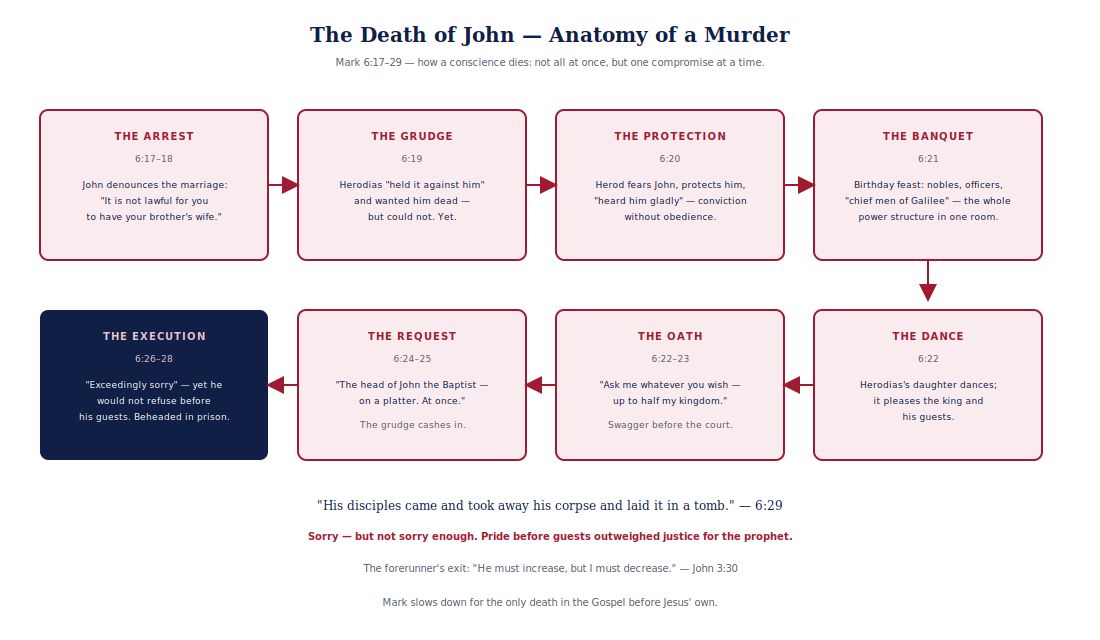
The arrest. Herod had married Herodias, "his brother Philip's wife" (6:17). (Herodias had divorced her living husband Philip — Antipas's half-brother — against Jewish law, to marry Herod Antipas; Antipas had likewise cast aside his own wife, Phasaelis, the daughter of King Aretas of Nabatea. A tangle of divorces and power.) 73 John had told Herod plainly: "It is not lawful for thee to have thy brother's wife" (6:18) — Leviticus 18:16 and 20:21 forbid it. For this, Herod "had sent forth and laid hold upon John, and bound him in prison" (6:17).
The grudge. "Therefore Herodias had a quarrel against him, and would have killed him; but she could not" (6:19). Why not? Because "Herod feared John, knowing that he was a just man and an holy, and observed him; and when he heard him, he did many things, and heard him gladly" (6:20).
This is the most psychologically tangled verse in Mark. Herod the tyrant likes listening to the prophet who condemns him. He protects John from his own wife's murderous grudge. He "did many things" at John's preaching — half-repentant, half-fascinated, wholly double-minded. You can enjoy a prophet's preaching and still refuse to obey it. Herod is the patron saint of entertained-but-unconverted listeners.
The banquet. Herod throws a birthday feast "to his lords, high captains, and chief estates of Galilee" (6:21) — the entire Galilean power structure in one room. Then "the daughter of the said Herodias" — Josephus names her Salome — "came in, and danced, and pleased Herod and them that sat with him" (6:22). 19
This was a court dance at a royal banquet — the kind of performance that delighted ancient banquet guests. Mark shows zero interest in the dance itself; his interest is entirely in what it purchased. The scandal of the story is not a dance — it's what follows.
The oath. Carried away, Herod swears: "Ask of me whatsoever thou wilt, and I will give it thee" — "half of my kingdom" (6:22–23). (He couldn't actually give half his kingdom — he ruled at Rome's pleasure. It's the swaggering hyperbole of a king showing off before his court.)
The request. The girl consults her mother — and Herodias, who has waited for this night, doesn't hesitate: "The head of John the Baptist!" (6:24). The girl returns "immediately, with haste" (6:25): "I want you to give me at once the head of John the Baptist on a platter."
The execution. "And the king was exceeding sorry; yet for his oath's sake, and for their sakes which sat with him, he would not reject her" (6:26). Sorry — but not sorry enough. Mark's word — perilypos, "exceedingly sorry" — is the same word Jesus will use of His own soul in Gethsemane (14:34). Real anguish; but it never became repentance. Pride before the guests outweighs justice for the prophet. He sends an executioner; John is beheaded in the prison; the head is brought on a platter to the girl, who gives it to her mother (6:27–28).
The burial. "When his disciples heard of it, they came and took up his corpse, and laid it in a tomb" (6:29). Quiet, faithful, devastating. The forerunner's ministry ends in a tomb — a foreshadowing Mark's readers would feel in their bones.
Where? Mark doesn't name the prison. The Jewish historian Josephus tells us John was held and executed at Machaerus, Herod's fortress-palace east of the Dead Sea. 19 Mark's silence on the location keeps the focus where he wants it: not on geography, but on the anatomy of a murder — grudge, lust, pride, and a room full of powerful cowards.
WORD STUDY
Offended / stumbled — skandalizomai (skahn-dah-LID-zo-my). From skandalon, a trap's trigger-stick. To be scandalized, tripped up, caused to stumble. Nazareth didn't reject Jesus with arguments — they tripped over His ordinariness. The carpenter's son became the thing they couldn't get past.
Anointed with oil — aleipho (ah-LAY-foh). The Twelve "anointed with oil many that were sick" (6:13). Aleipho is the everyday Greek word for rubbing something on — the word for medicine, not ceremony (the ritual word was chrio). Oil was medicine in the ancient world (Isaiah 1:6; Luke 10:34) — and, set apart by prayer, a symbol of the Spirit's healing presence. 377427 Mark holds both together: ordinary means, extraordinary God. (James 5:14 continues the practice.)
Half my kingdom — Herod's oath (6:23) echoes Ahasuerus to Esther ("to the half of the kingdom," Esther 5:3; 7:2) — the stock boast of an Eastern king showing off. 75 Mark wants you to hear the parallel and feel the inversion: Esther used the offer to save her people; Herodias uses it to murder a prophet.
"He could there do no mighty work" — what unbelief costs
The hardest sentence in the lesson is 6:5. Two guardrails: (1) It does not mean human unbelief overpowers divine omnipotence — as if Nazareth voted God's power down. (2) It does mean Jesus' mighty works are revelatory, not coercive: they reveal the kingdom to faith, and He won't perform them as proof for those who've decided not to believe. Unbelief doesn't make Him powerless; it makes Him silent — which, for Nazareth, was the greater judgment. (Matthew 13:58 says it even more plainly: "He did not many mighty works there because of their unbelief.")
Familiarity: the quietest killer of faith
Nazareth's problem wasn't hostility — it was over-familiarity. They didn't hate Jesus; they just couldn't imagine Him being more than they remembered. This is the danger for lifelong churchgoers: you can know all about Jesus and still be astonished at Him rather than by Him — the crowd's first reaction (6:2) curdled into offense (6:3) because wonder wasn't allowed to become worship. Ask yourself: is there a version of Jesus you've outgrown hearing from — the Jesus of your childhood, your old church, your assumptions?
Herod: the tragedy of the entertained conscience
Herod "heard John gladly" (6:20). He protected him. He "did many things." And he still had him killed to save face at a party. Conviction without obedience curdles into guilt — and guilt, nursed long enough, starts looking for a way to silence the voice. Herod's arc is a warning: you can admire a prophet, enjoy his preaching, even defend him — and still, when the banquet crowd is watching, choose your image over your soul.
Why Mark sandwiches mission between rejections
Look at the structure: rejection at Nazareth (6:1–6) → the Twelve sent out (6:7–13) → John's execution (6:14–29). Mark places the church's first mission trip between two pictures of what rejection costs. The message to every disciple: the mission advances through rejection, not around it. Nazareth's unbelief didn't stop the Twelve; Herod's violence didn't stop the kingdom. It never does.
The Christ Thread
Messianic promise — Christ in His own story. Jesus reads His hometown rejection through the prophet's proverb (6:4) — and Mark wants you to hear the deeper note: this is the rejected stone of Psalm 118:22, which Jesus Himself will quote in 12:10. The hometown that won't have Him, the palace that beheads His forerunner — Mark is showing you, in miniature, the cross: the King rejected by His own (John 1:11). And John? His death is the only martyr's death in the Gospel before Jesus' — the forerunner goes first into the tomb, and the pattern is set: the kingdom's way runs through rejection to resurrection.
OT/NT parallels — where the New Testament picks it up. Stephen will preach the pattern to the Sanhedrin: "Which of the prophets have not your fathers persecuted?" (Acts 7:52). Matthew tells John's death too (14:1–12), adding Herod's haunted verdict: "It is John... he is risen from the dead." And John's own epitaph, spoken while he was still free: "He must increase, but I must decrease" (John 3:30) — fulfilled at Machaerus.
The Christian future — what this foreshadows for us. The Twelve going out between the rejections is the church's permanent assignment: the mission advances through rejection, not around it. Acts will show it again and again — persecution scatters, the gospel spreads. And Nazareth's warning stands for every generation: familiarity with holy things is the besetting temptation of God's own people. Expect the hometown treatment; go anyway.
Where in the Covenant Story?
John is the hinge. Jesus called him the greatest "among them that are born of women" (Matthew 11:11) — the last and greatest prophet of the old covenant, closing the age of promise. His death at Machaerus ends the old order's story; the Twelve, sent out two by two in the middle of this lesson, are the firstfruits of the new-covenant people. And note the thrones: Herod — a client king ruling at Rome's pleasure — sits in a palace while the true Davidic King is dismissed in His hometown synagogue. The covenant promises are being kept upside-down from the world's point of view: the real kingdom advances through fishermen, not palaces.
WHAT THE CHURCH HAS ALWAYS BELIEVED: The ancient church honored John the Baptist as the bridge between the covenants — the last prophet of the old age — the forerunner in death as in life. His death prefigures Christ's: the righteous one killed by power protecting itself.
It's Okay to Ask
Honest questions this passage raises — bring them, don't bury them:
- Did Nazareth's unbelief really limit God? Can my doubt block His work in my life? (Not His power — His revelation. Jesus doesn't coerce faith with signs; persistent, principled refusal shuts you out of what He wants to show you. See "He could there do no mighty work" above.)
- Why does Mark spend sixteen verses on a beheading? Isn't this just palace gossip? (Because it's the anatomy of how a conscience dies — grudge, pride, cowardice — and the only martyr's death in the Gospel before Jesus'. Mark slows down where it matters.)
- Herod "heard John gladly" — so was he a believer? (He enjoyed the preaching and protected the preacher — and still chose his image over his soul. Being moved isn't being changed. That's the warning.)
Watch Out — the enemy works through the banquet
Mark doesn't name Satan in this chapter — but his fingerprints are on the banquet. A grudge nursed for months (Herodias, 6:19). Pride fed before an audience (Herod's oath, 6:23). Truth silenced to save face (6:26). The enemy rarely arrives with horns here; he arrives as a dinner party where image matters more than justice. Watch out: conviction you won't act on doesn't stay neutral — it curdles, and eventually it looks for a way to silence the voice. Herod's arc is what happens when "sorry" never becomes "I repent."
FACT, INFERENCE, OR DISPUTED?
- FACT: Herod Antipas married Herodias, his brother Philip's wife; John denounced the marriage as unlawful (6:17–18); Herodias held a grudge (6:19).
- FACT: Josephus (Antiquities 18.116–119) confirms John's imprisonment and execution at Machaerus and gives the political motive: Herod feared John's influence over the crowds might spark a revolt. 19
- DISPUTED (textual): 6:20 — KJV reads "he did many things"; some early manuscripts read "he was very perplexed" (one letter's difference in the Greek). The portrait is the same either way: fascinated, but unconverted.
- INFERENCE: Mark arranges Nazareth → mission → John's death deliberately, framing the Twelve's mission between two rejections.
- DISPUTED: The precise relationship tangle (which "Philip"). Josephus calls Herodias' first husband "Herod" (son of Herod the Great by Mariamne the high priest's daughter); Mark (6:17) and Matthew (14:3) call him "Philip" — most probably the same man bearing the family double-name. 45 He is not Philip the tetrarch (Luke 3:1), who later married Salome. The family tree of the Herods is notoriously knotted; the moral point — an unlawful marriage — is undisputed.
SCHOLAR'S NOTE: Machaerus still stands — or rather, its ruins do, on a lonely hilltop east of the Dead Sea in modern Jordan. The Hasmonean king Alexander Jannaeus built it as a desert fortress (c. 90 BC); the Roman general Gabinius destroyed it (57 BC); Herod the Great rebuilt and enlarged it into a palace-fortress, which his son Antipas inherited and used as a royal residence. 76 Archaeologists have uncovered its royal courtyard, baths, and a lower courtyard with mikva'ot (ritual baths). Standing there, you look west across the Dead Sea toward Judea — the view John would have had from his cell. Josephus says Herod feared John's popularity might spark a revolt — a political motive Mark doesn't mention, focused as he is on the moral one. Both can be true: tyrants usually have more than one reason. (Josephus adds a chilling coda: Antipas's spurned first wife, Phasaelis, fled to her father King Aretas — whose armies crushed Antipas in AD 36 — and the Jews saw that defeat as God's judgment for John's death, Antiquities 18.5.1–2.) 7319
Cross-references (explained, not just listed)
- Leviticus 18:16; 20:21 — the law John cited: taking a brother's wife is forbidden. John wasn't meddling in politics; he was preaching Torah to a king.
- Esther 5:3; 7:2 — "to the half of the kingdom": Herod's oath echoes Ahasuerus — but Esther's banquet saved a people; Herod's murdered a prophet.
- Matthew 14:1–12; Luke 9:7–9 — the parallel accounts; Luke adds Herod's perplexity: "John have I beheaded: but who is this, of whom I hear such things?" (9:9).
- John 3:30 — "He must increase, but I must decrease": the forerunner's own epitaph, fulfilled at Machaerus.
Go Deeper
Hungry for more? Two doors worth opening:
- Read Matthew 14:1–12 — the parallel account, with Herod's haunted conclusion: "It is John... he is risen from the dead."
- Read Acts 7:51–53 — Stephen's speech: the rejected-prophet pattern across Israel's whole history, ending at Jesus.
Theological truth (arising from the text)
God does not force His wonders on the unwilling (Nazareth), and He does not abandon His mission to the violent (Herod). Rejection — by the familiar or the powerful — is the normal context of the kingdom's advance, not its failure. The Twelve go out between the rejections, and the Gospel goes with them. And the mission is Trinitarian to its core: the Father sends the Son, the Son sends the Twelve, and the Spirit's power goes with them — one divine mission, shared by three Persons.
Humble — and confident
Humble, because Nazareth is uncomfortably close to home. We who grew up around Jesus — in church, in Christian homes, in the language — are most at risk of the hometown disease: knowing about Him so well we stop expecting anything from Him. And Herod is close too: who hasn't enjoyed a challenging sermon and then chosen comfort at the banquet?
Confident, because rejection doesn't stop the kingdom. Between Nazareth's unbelief and Herod's violence, Jesus sent out the Twelve — and they preached, cast out demons, and healed. Your mission doesn't require everyone's approval. It never did.
Confess It
Herod's tragedy began with a conviction he enjoyed but never obeyed. Name one "glad hearing" in your life — a sermon, a verse, a prompting you've admired from a distance — and confess the gap between hearing and doing (1 John 1:9). Then close the gap this week: do the obedient thing.
For discussion
- Nazareth stumbled over Jesus' ordinariness. Is there a "carpenter's son" in your life — someone God might be speaking through that you've dismissed as too ordinary?
- Herod "heard John gladly" but obeyed never. What's the difference between enjoying a sermon and obeying one — and which are you doing?
- The Twelve were sent out between two rejections. Where is God calling you to act in spite of rejection rather than waiting for approval?
What He has done (the indicative)
Before one "you should," hear what He did: Jesus walked into His hometown knowing exactly how it would go — and went anyway. He put His own authority over unclean spirits into the hands of twelve ordinary men and sent them out between the rejections. And John finished faithful — a lamp burning until a grudge snuffed it out. The kingdom doesn't wait for a welcome; it advances on the King's command. Every step below is a response to that courage, not a way to earn it.
This week's practices
- The Nazareth examen. Ask: "Where have I stopped expecting Jesus to surprise me?" Write down one area where familiarity has replaced faith — and pray Mark 6:6 over it ("Lord, don't let me be the hometown crowd").
- Obey one "glad hearing." Think of one sermon, verse, or conviction you've enjoyed but never obeyed. Do the obedient thing this week — the one Herod wouldn't do.
- Shake the dust. Is there a rejection you're still carrying — a door that closed, a person who dismissed you? Name it, pray for them, and consciously "shake the dust": release the outcome to God and keep walking.
- Pray It Back. Pray Mark 6:4 back to God: "Lord, make me someone who gives Your prophets honor — starting with You. Where I've been the hometown crowd, astonish me again."
- Memorize Mark 6:4. The prophet's proverb — and a guard against hometown unbelief in your own heart.
For Us Together
Ask your small group or family: "Where have we stopped expecting Jesus to surprise us — not just me, but us? What's our corporate Nazareth?" Familiarity is contagious; so is fresh faith. Name it together.
Who Needs This?
Who in your life is doing the Herod thing — enjoying truth without obeying it, choosing image over soul? One name. One honest, gentle conversation this week — not to shame them, but to warn them while there's still time.
Take It Home
At the table or at bedtime, ask your kids: "John told the king the truth even though it got him thrown in prison. When is it hard to tell the truth? What would you do if telling the truth got you in trouble?" Praise courage, not just correctness — the kingdom needs truth-tellers.
Praise Him
Don't end with a to-do list — end with worship. Right now, out loud or in writing, finish this sentence: "Father, I praise You because in this passage I saw that You _____." (Send Your mission through rejection? Never waste a prophet's faithfulness? Give ordinary Twelve Your own authority?) Sit in it for a minute. Theology that doesn't become doxology hasn't finished its work.
The bottom line
Familiarity said "we know Him" and missed Him; power said "I'm sorry" and killed Him anyway. But between the two rejections, the Twelve went out two by two — and the kingdom advanced. Mark 6:1–29 is the Gospel's honest warning and its defiant hope: rejection is normal, and it never gets the last word.