
Before You Read: Open My Eyes
Before you read a single verse, pray this — out loud if you can:
"Father, Your Spirit breathed out these words. I come with my own not-enough — needs bigger than my resources, a heart that can watch miracles and still not understand. Open my eyes to the Shepherd who feeds, and to the figure walking toward me on my 3 AM water. In Jesus' name, amen."
(Psalm 119:18 — "Open thou mine eyes, that I may behold wondrous things out of thy law.")
Welcome
The Twelve return from their first mission trip — tired, buzzing with stories — and Jesus tries to give them a rest. It doesn't work. Instead, this lesson gives us the most famous miracle of Jesus' public ministry — told in all four Gospels (the only one of His ministry miracles with that distinction; the resurrection accounts stand in a category of their own) — a midnight walk on water, and a lakeside revival.
One feeding frames the lesson's question: what do you do when the need is bigger than your resources? The disciples do the math. Jesus does the miracle. And Mark makes sure you notice the difference.
CHECK WHAT YOU THINK YOU KNOW
- ☐ "The feeding of the 5,000 is only in John." (It's in all four Gospels — the only one of His public-ministry miracles with that distinction. The resurrection is told in all four too, in a category of its own.)
- ☐ "The disciples had no food at all for the crowd." (They had something — just not enough.)
- ☐ "Jesus walked on water to show off His power." (Mark gives a quieter, stranger reason.)
- ☐ "The disciples finally understood who Jesus was after all this." (Read 6:52 carefully.)
Where we are in the story
The apostles — Mark only uses the word "apostles" here (6:30), literally "sent ones" 7778 — return from the mission of 6:7–13 and "gathered themselves together unto Jesus, and told him all things, both what they had done, and what they had taught" (6:30). The first debrief in church history. And Jesus' response is pure pastoral wisdom: "Come ye yourselves apart into a desert place, and rest a while" (6:31).
Deserted place (eremos topos) — the wilderness again, Mark's favorite setting for God's work. But rest proves impossible: "there were many coming and going, and they had no leisure so much as to eat" (6:31). Ministry success has eaten their lunch — literally.
Scene 1: Compassion before rest (6:32–34)
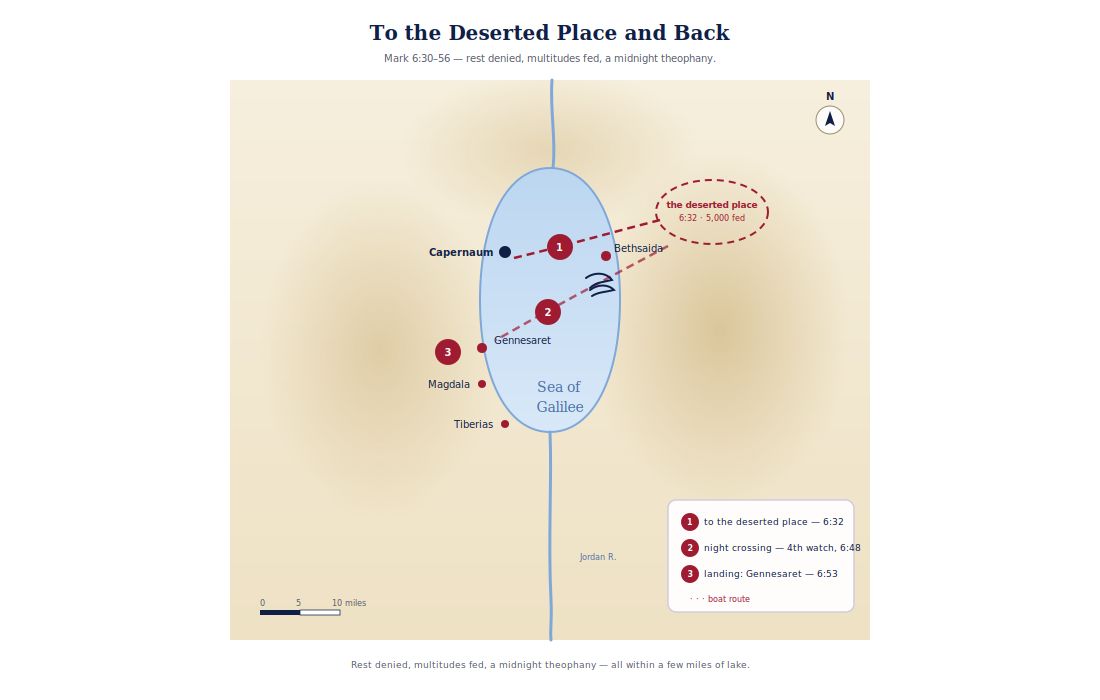
They sail for the deserted place — but the crowds see them leaving, run ahead on foot around the lake, and arrive first (6:33). Imagine the disciples' faces: the rest they were promised, evaporating on the far shore.
Jesus' response is the emotional key to the whole lesson: "And Jesus, when he came out, saw much people, and was moved with compassion toward them, because they were as sheep not having a shepherd: and he began to teach them many things" (6:34).
Moved with compassion — splanchnizomai, the gut-churning word (1:41; 8:2). 74 And notice what compassion does: it doesn't start with bread. It starts with teaching. The crowd is hungry, but Jesus diagnoses the deeper hunger first — sheep without a shepherd need truth before they need lunch. (The phrase echoes Ezekiel 34, where God condemns Israel's false shepherds and promises, "I will feed my flock, and I will cause them to lie down." Mark's readers hear it: the true Shepherd has arrived.)
Scene 2: "Give ye them to eat" (6:35–44)
Evening comes. The disciples do the responsible thing — the managerial thing: "This is a desert place, and now the time is far passed. Send them away, that they may go into the country round about, and into the villages, and buy themselves bread" (6:35–36). Reasonable. Kind, even. Logistically flawless.
Jesus' reply is not: "Bring them hither to me." It's: "Give ye them to eat" (6:37).
The disciples blink: "Shall we go and buy two hundred pennyworth of bread, and give them to eat?" A denarius was a day's wage for a laborer — 200 denarii is roughly eight months' pay. 2879 Their math is correct and their conclusion is despair: impossible.
Jesus doesn't argue the math. He asks an inventory question: "How many loaves have ye? go and see" (6:38). They report back: "Five, and two fishes."
Five small barley loaves (John 6:9 tells us they were barley — the poor person's bread) and two fish. For 5,000 men (6:44) — plus women and children by Matthew's count. The disciples bring their not-enough to Jesus. That is the entire economy of the kingdom in one gesture.
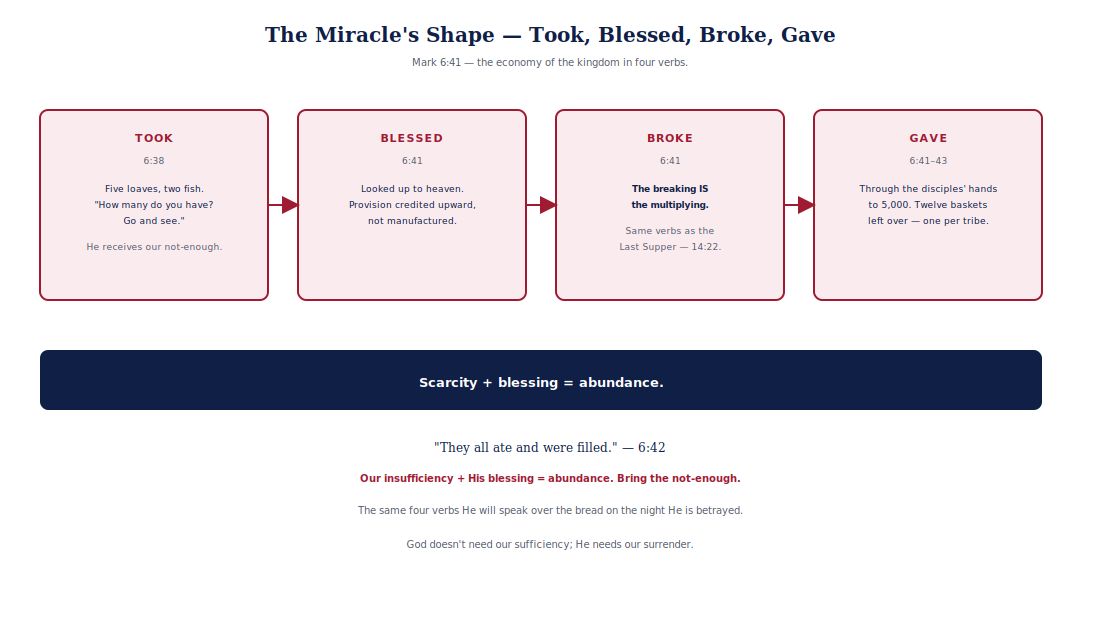
What follows is deliberately, unmistakably Eucharistic — Mark uses the same four verbs he'll use at the Last Supper (14:22): "And when he had taken the five loaves and the two fishes, he looked up to heaven, and blessed, and brake the loaves, and gave them to his disciples to set before them" (6:41).
- Took — He receives what they have, however small.
- Blessed — He looks to heaven; the provision is credited upward.
- Broke — the breaking is the multiplying (in Mark's telling, the miracle happens in the breaking).
- Gave — through the disciples' hands. Jesus could have rained bread; instead He makes them the waiters. The miracle needs distributors.
"And they did all eat, and were filled. And they took up twelve baskets full of the fragments, and of the fishes" (6:42–43). Twelve baskets — one for each disciple, one for each tribe of Israel. The God who fed Israel with manna in the wilderness (Exodus 16) is feeding them again — and there are leftovers, because God's provision always exceeds the need. Scarcity + blessing = abundance. That's the math of the kingdom.
Scene 3: The fourth watch (6:45–52)
"And straightway he constrained his disciples to get into the ship, and to go to the other side before unto Bethsaida" (6:45) — while He stays to dismiss the crowd and goes "into a mountain to pray" (6:46). (Note the textual wrinkle: they were near Bethsaida already; some manuscripts smooth this differently. Mark's geography here is famously debated — the point stands: Jesus sends them across while He prays alone.)
Evening falls. The boat is "in the midst of the sea"; Jesus is "alone on the land" (6:47). He sees them — Mark says — "toiling in rowing; for the wind was contrary unto them" (6:48). Miles away, in the dark, on a mountain: He sees. Hold that.
"About the fourth watch of the night he cometh unto them, walking upon the sea" (6:48). The Romans divided the night into four watches; the fourth is 3 to 6 AM. 28 They've been rowing against the wind for hours — most of the night. And here comes Jesus, walking on the waves.
Then Mark's strangest detail: "and would have passed by them" (6:48).
Passed them by?! Is He teasing them? Showing off? No — Mark's readers knew their Bibles. "Passing by" is what God does when He reveals His glory: to Moses — "I will make all my goodness pass before thee" (Exodus 33:19); to Elijah — "the LORD passed by" (1 Kings 19:11). 8024 This isn't a stroll; it's a theophany — God revealing Himself in the act of passing by. Jesus isn't showing off. He's showing who He is.
The disciples, naturally, conclude the only sensible thing: "it's a ghost" — and scream (6:49–50). Then: "Be of good cheer; it is I; be not afraid" (6:50). In Greek, "It is I" is ego eimi — "I AM" — the divine name (Exodus 3:14). 2415 On the waves, in the dark, Jesus speaks the name of God.
He gets in. The wind ceases. And Mark delivers the most sobering verse in the lesson: "they were sore amazed in themselves beyond measure, and wondered. For they considered not the miracle of the loaves: for their heart was hardened" (6:51–52).
Read that again. After all of this — the feeding, the walking on water — they still don't get it. "Hardened heart" (poroo — calloused, like skin gone thick) is Mark's diagnosis, and he applies it to the disciples, not the Pharisees. If that doesn't humble every Bible student, nothing will. Understanding Jesus isn't a matter of seeing enough miracles — it's a matter of the heart.
Scene 4: The hem of His garment (6:53–56)
They land at Gennesaret — the fertile plain on the lake's northwest shore. "And when they were come out of the ship, straightway they knew him" (6:54). Word spreads like fire: the sick are brought on beds; "And whithersoever he entered, into villages, or cities, or country, they laid the sick in the streets, and besought him that they might touch if it were but the border of his garment: and as many as touched him were made whole" (6:56).
The hem (kraspedon) — the tassels on a Jewish man's garment (Numbers 15:38–39), the fringes that marked covenant identity. Remember the bleeding woman (5:28): "If I may touch but his clothes." Now everyone knows. Faith has gone viral: touch the hem, be made well. Mark closes the chapter the way it opened — with crowds so thick there's no leisure, and a compassion that never rations itself.
WORD STUDY
Compassion — splanchnizomai (splahngkh-NID-zo-my). A gut-word: the inner organs churning. In Mark, Jesus "has compassion" only three times (1:41; 6:34; 8:2) — and each time, action follows immediately. This isn't sentiment; it's mercy with its sleeves rolled up.
Deserted place — eremos topos (EH-reh-mos TOH-poss). The wilderness, again — Mark's thin place, where God feeds His people (Exodus 16; 1 Kings 19; Mark 1:12–13). The disciples wanted rest from the crowds; Jesus gives them rest for the crowds — by showing them the Shepherd.
Baskets — kophinos (KOH-fee-noss). A small Jewish wicker lunch-basket — the kind Jews carried to keep their food ritually separate. 8182 Twelve of them, full of leftovers: one per disciple, one per tribe. Nothing wasted; everyone provided for. (Mark uses a different Greek word, sphyris — a larger hamper — for the feeding of the 4,000, and later has Jesus quiz the disciples on the two words (8:19–20). He keeps his baskets straight.)
Hardened — poroo (poh-ROH-oh). To petrify, to grow calloused — like skin thickening over a wound. 32 Mark uses it of the disciples' hearts (6:52), not their enemies'. Miracles don't soften hearts; only surrender does.
"Give ye them to eat" — the impossible assignment
Jesus doesn't ask the disciples to find food for 5,000. He tells them to provide it. The command is impossible on purpose — it's the same pedagogy as "be perfect" (Matthew 5:48): commands we can't fulfill drive us to the One who can. The disciples' inventory ("five loaves, two fish") becomes the raw material of the miracle only after they admit it's not enough. God doesn't need our sufficiency; He needs our surrender. Bring the not-enough. Watch what He does with it.
The four verbs: took, blessed, broke, gave
Mark 6:41 and Mark 14:22 (the Last Supper) share the identical fourfold action. This is not coincidence — it's preparation. Every time the early church broke bread at the Table, they'd remember the hillside: the same Lord who multiplied loaves would soon break His own body. The feeding is a preview of the Supper, and the Supper is the meaning of the feeding — God feeds His people with Himself.
"Would have passed by them" — the theophany on the waves
Don't domesticate 6:48. In Exodus 33 and 1 Kings 19, God's "passing by" is how He reveals His glory to Moses and Elijah — the two greatest prophets. Mark is telling you, without raising his voice: the figure on the waves is doing what YHWH does. Add ego eimi ("I AM," 6:50), and the claim is unmistakable. The disciples thought "ghost"; Mark wants you to think "God."
Why didn't they understand? The hardened heart
6:52 is Mark's most honest sentence about the Twelve — and his most hopeful one for us. They'd distributed the miracle bread with their own hands and still didn't understand. Proximity to power doesn't produce perception. What opens blind eyes in Mark isn't more evidence — it's the cross (15:39: the centurion sees Jesus die and confesses). If you're frustrated that you "should" understand more by now, you're in the disciples' boat — and that's exactly where Jesus keeps showing up.
The Christ Thread
Messianic promise — Christ in His own story. This lesson is one of Mark's highest Christological peaks. The four verbs of the feeding — took, blessed, broke, gave — are the Last Supper in preview: the same Lord who multiplies bread will break His own body. On the waves, "would have passed by them" (6:48) is theophany language — what YHWH does in Exodus 33:19–22 and 1 Kings 19:11 — and "It is I" is ego eimi, "I AM" (Exodus 3:14). Mark is identifying Jesus, without raising His voice, as the God who fed Israel with manna and who alone "treads on the waves of the sea" (Job 9:8).
OT/NT parallels — where the New Testament picks it up. John 6 is the full sermon on this miracle — the Bread of Life discourse, where Jesus says plainly what Mark shows in action: "I am the bread of life." Paul's Supper in 1 Corinthians 11 runs on the same four verbs. And the manna story (Exodus 16) is the deliberate backdrop: what YHWH did for Israel in the desert, Jesus now does in person.
The Christian future — what this foreshadows for us. Every feeding previews the final feast: Isaiah's banquet "for all people" (25:6), the marriage supper of the Lamb (Revelation 19:9). And "He saw them toiling in rowing" (6:48) — miles away, in the dark — is the permanent promise: the ascended Christ still sees His rowers (Hebrews 7:25 — He lives to intercede). Your 3 AM is watched.
Where in the Covenant Story?
The wilderness feeding deliberately replays the exodus: manna in the desert (Exodus 16), but now the true Shepherd feeds them Himself — the new exodus Isaiah promised, arriving in person. Twelve baskets — one for each tribe: the new-covenant people being gathered around a greater Moses. The old covenant fed Israel for a journey through the wilderness; the new covenant feeds all who come to the Son — and the leftovers testify that God's provision always exceeds the need.
Father, Son, and Spirit
Watch the persons at work in 6:41: the Son receives the loaves, looks up to heaven — to the Father — and gives thanks; the provision is credited upward, then distributed through human hands. The Father's ancient shepherd promise — "I, even I, will both search my sheep" (Ezekiel 34:11) — is enacted by the Son on the hillside. One divine compassion, expressed through the Son's hands, sourced in the Father's heart. When Jesus has compassion (splanchnizomai, 6:34), you are watching the heart of God in human form.
WHAT THE CHURCH HAS ALWAYS BELIEVED: From the earliest centuries, the church heard the feeding's four verbs — took, blessed, broke, gave — as the shape of the Lord's Supper. The Didache and the early liturgies confess Christ the feeder as Christ the food: the same Lord who multiplied bread gives Himself as bread.
It's Okay to Ask
Honest questions this passage raises — bring them, don't bury them:
- Did Jesus really mean "give ye them to eat"? Was He setting them up to fail? (Yes — and that's the pedagogy. Impossible commands drive us to the Commander. The inventory only becomes miracle material after they admit it's not enough.)
- Why didn't the disciples understand — after all that? Am I that dull too? (Probably. And that's why Mark tells you so bluntly. Dullness is curable — Peter's confession is two chapters away — and Jesus keeps using the dull in the meantime.)
- Was Jesus showing off, walking on water? (No — "passing by" is theophany language, not theater. He was revealing who He is, not performing what He can do.)
FACT, INFERENCE, OR DISPUTED?
- FACT: All four Gospels record the feeding of the 5,000 — the only miracle of Jesus' public ministry with that distinction. 8384 (The resurrection accounts stand in a category of their own.) (Matthew 14; Mark 6; Luke 9; John 6).
- FACT: 200 denarii ≈ 200 days' wages — roughly eight months' pay for a laborer.
- INFERENCE: The four verbs (took/blessed/broke/gave) deliberately echo the Last Supper — Mark preparing his readers for chapter 14.
- INFERENCE: "Passed them by" (6:48) evokes the theophanies of Exodus 33 and 1 Kings 19 — a divine self-revelation, not a casual stroll.
- DISPUTED: The exact route of 6:45 ("to Bethsaida") vs. the landing at Gennesaret (6:53). An old fix — two Bethsaidas, one on each shore — has no evidence behind it and has been largely abandoned by scholars; 85 the likelier explanations are that Bethsaida was the intended first stop (John 6:17 names Capernaum as the destination) and the storm blew them off course. 5 The events, not the itinerary, are Mark's focus.
SCHOLAR'S NOTE: John 6:9 identifies the loaves as barley — the bread of the poor (wheat was for the better-off). 50 So the miracle's raw material is a poor boy's lunch (John tells us where the lunch came from; Mark doesn't). And the "green grass" of 6:39 is a small chronological clue: Mark mentions it because it was spring, near Passover (John 6:4 confirms the season) — which is why 5,000 people could sit on grass in the hills. 5061 Details like this are why scholars take the Gospels' historical texture seriously.
Cross-references (explained, not just listed)
- Exodus 16 — manna in the wilderness: the Old Testament's feeding miracle; Mark's "deserted place" feeding is its echo.
- Ezekiel 34:11–16 — "I, even I, will both search my sheep": the shepherd promise behind "sheep not having a shepherd" (6:34).
- 2 Kings 4:42–44 — Elisha feeds 100 with 20 loaves ("Give the people, that they may eat") — the prophetic preview; Jesus outstrips it fiftyfold, feeding fifty times as many people with a quarter of the loaves.
- Exodus 33:19–22; 1 Kings 19:11 — God's "passing by": the background of 6:48's strangest detail.
- Mark 14:22 — the four verbs at the Last Supper: took, blessed, broke, gave.
Go Deeper
Hungry for more? Two doors worth opening:
- Read John 6 — the Bread of Life discourse: John's full sermon on this very miracle, including the hard sayings the crowds walked away from.
- Read Exodus 16 — the manna story Mark is echoing. Compare the two wilderness feedings: what YHWH did through Moses, Jesus now does in person.
Theological truth (arising from the text)
God's compassion doesn't wait for convenient conditions (no rest, no food, no understanding — He works anyway). His provision flows through surrendered insufficiency, not through our competence. And He reveals Himself most clearly not in our grasping but in our need: on the waves at 3 AM, to rowers who'd given up.
Humble — and confident
Humble, because the disciples had just returned from casting out demons and healing the sick (6:13) — and immediately failed the math test. Past victories don't vaccinate against present unbelief. If they could distribute miracle bread and still have hardened hearts (6:52), we should hold our own spiritual résumé very lightly.
Confident, because Jesus doesn't wait for our understanding before He uses us. He put the bread in the hands of men who didn't get it — and 5,000 ate. He walks toward rowers who think He's a ghost. Your not-enough, surrendered, is His raw material.
Confess It
The disciples' math was correct — and it talked them out of trust. Name one place where your "correct math" has become an excuse for unbelief, and confess it (1 John 1:9): "Lord, I've trusted my calculations more than Your compassion. Forgive my practical atheism."
For discussion
- "Give ye them to eat" — what's your 5,000-person problem right now: the need so big your resources are laughable? What would "bringing the loaves" look like?
- The disciples' hearts were "hardened" after the miracle (6:52). Why do you think seeing wonders doesn't automatically produce faith? What does?
- Jesus tried to give them rest, the crowds stole it, and He had compassion anyway. Where do you most need His compassion to override your exhaustion?
What He has done (the indicative)
Before one "you should," hear what He did: the Shepherd saw sheep without a shepherd and had compassion — before they asked, before they deserved it. He took a boy's lunch and fed thousands, with twelve baskets to spare. At 3 AM He came walking on the water toward rowers who thought He was a ghost — and got in the boat anyway. He keeps using the dull, the tired, the hardened-hearted. That includes us. Every step below is a response to that compassion, not a way to earn it.
This week's practices
- The inventory prayer. Write down your "five loaves and the two" — the resources that feel laughably small for the need in front of you. Pray: "Lord, I bring my not-enough. Take, bless, break, give." Then watch for the distributors' role He's giving you.
- Shepherd-first compassion. Before you fix someone's practical need this week, do what Jesus did in 6:34: teach first — share one true thing about God with them. Compassion starts with truth.
- The 3 AM watch. One night this week, when worry wakes you (or set an alarm for the fourth watch), pray instead of scrolling: "Be of good cheer; it is I." Write down what He says.
- Pray It Back. Pray Mark 6:34 back to God: "Jesus, Shepherd — You saw the crowd and had compassion before they asked. See me the same way today. Teach me before You feed me; I need truth more than lunch."
- Memorize Mark 6:34. The Shepherd's heart in one verse — for the days you're the sheep without one.
For Us Together
Ask your small group or family: "What are our 'five loaves' — the small, embarrassing resources we're tempted to hide? What would happen if we brought them together to Him?" The miracle needed distributors; the kingdom still does. Nobody feeds 5,000 alone.
Who Needs This?
Who in your life is straining at the oars at 3 AM — exhausted, going nowhere, wind against them? One name. Go to them this week the way He came to the boat: show up, speak peace, get in.
Take It Home
At the table or at bedtime, ask your kids: "If you had five loaves and two fish and 5,000 hungry people showed up, what would you do? The disciples gave their not-enough to Jesus — and everyone ate. What's your 'not-enough' you could give Him this week?"
Praise Him
Don't end with a to-do list — end with worship. Right now, out loud or in writing, finish this sentence: "Father, I praise You because in this passage I saw that You _____." (Feed multitudes from a boy's lunch? Walk on my darkest water? Use disciples who don't understand?) Sit in it for a minute. Theology that doesn't become doxology hasn't finished its work.
The bottom line
Rest denied. Multitudes fed from a boy's lunch. A midnight theophany for exhausted rowers. Mark 6:30–56 is the Gospel's answer to every "not enough" we'll ever face: bring what you have, watch Him bless and break it, and pick up the twelve baskets of leftover grace.