
Before You Read: Open My Eyes
Before you read a single verse, pray this — out loud if you can:
"Father, I come to this passage the way the disciples did — ambitious, anxious, clutching my 'one thing.' Open my eyes to see greatness the way Jesus measures it: down, not up. Show me what has me, and give me grace to release it. In His name, amen."
(Psalm 119:18 — "Open thou mine eyes, that I may behold wondrous things out of thy law.")
Welcome
They've just seen glory on the mountain. Now comes the pop quiz — and the disciples fail it spectacularly. Arguing about who's the greatest. Trying to bench an outsider. Fretting over wealth. In this lesson, Jesus takes the world's ladder of greatness and flips it upside down: the way up is down.
From a child placed in the middle of a quarrel to a rich young man who walks away sad, Mark 9:30–10:31 is Jesus' masterclass on what greatness actually looks like in His kingdom.
CHECK WHAT YOU THINK YOU KNOW
- ☐ "Jesus taught that being rich is a sin." (Not quite — the problem is subtler and closer to home.)
- ☐ "'The eye of the needle' was a small gate in Jerusalem's wall." (A popular sermon illustration with no ancient evidence — see the Scholar's Note.)
- ☐ "Jesus said divorce is always wrong, no exceptions." (Mark states the creation ideal without qualification — but don't miss what Matthew adds.)
- ☐ "By chapter 10 the disciples were finally getting it." (They're still arguing about who's greatest.)
Where we are in the story
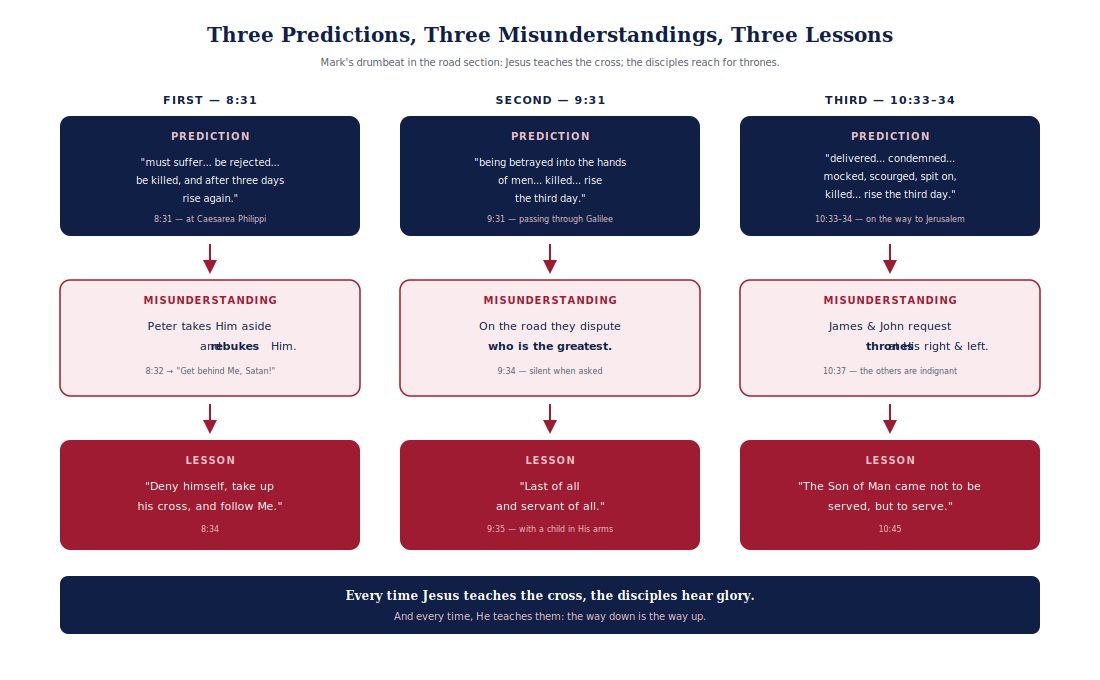
We're "on the way" — the long road section of Mark (8:27–10:52) where Jesus trains the Twelve for what's coming in Jerusalem. The pattern of this section is now unmistakable: prediction → misunderstanding → lesson. It happened at 8:31–33 (Peter's rebuke). It happens again here (9:31–35). It will happen a third time (10:33–45, next lesson).
Check What You Think You Know
Many sincere Christians have heard that the "eye of a needle" (10:25) was a small gate in Jerusalem's wall that camels squeezed through on their knees — making Jesus' saying about difficulty, not impossibility. There is no evidence such a gate ever existed. Jesus meant exactly what He said: it is impossible — "with men it is impossible" (10:27). That's the point. The disciples grasped it at once ("Who then can be saved?"), and Jesus answered with the gospel: "with God all things are possible." Don't soften the impossibility; it's what makes the grace astounding.
Scene 1: The prediction they're afraid to question (9:30–32)
Jesus leads the Twelve through Galilee quietly — "he would not that any man should know it" (9:30). The crowds are paused; this stretch is classroom time. And the lesson is the second passion prediction:
"The Son of man is delivered into the hands of men, and they shall kill him. And after that he is killed, he shall rise the third day." (9:31)
Note the present tense — "is being betrayed." The machinery is already moving (Judas — the one who carried the money box and habitually stole from it, John 12:6). And the disciples' response? "But they understood not that saying, and were afraid to ask him" (9:32). The last time someone questioned a prediction, he got called Satan (8:33). So they stay silent — and change the subject to something safer: themselves.
Scene 2: Who's the greatest? (9:33–37)
In Capernaum, "in the house," Jesus asks what they were arguing about on the road. Silence. They know exactly how it sounds: "they had disputed among themselves, who should be the greatest" (9:34).
Jesus sits down — the posture of a rabbi about to teach — and inverts the ladder:
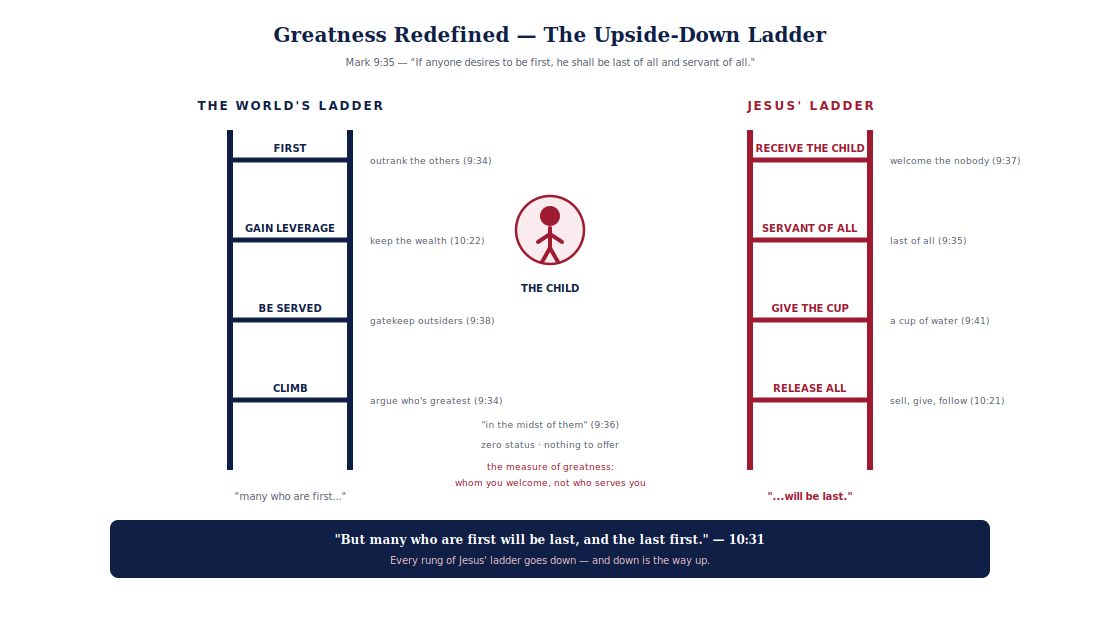
"If any man desire to be first, the same shall be last of all, and servant of all." (9:35)
Then the object lesson: He takes a little child, sets him "in the midst of them," takes him in His arms, and says:
"Whosoever shall receive one of such children in my name receiveth me; and whosoever shall receive me, receiveth not me, but him that sent me." (9:37)
In the ancient world, children had no status — no rights, no honor, no leverage. They were the ultimate nobodies. Jesus' point is devastating to ambition: greatness isn't measured by who serves you, but by whom you're willing to welcome. Receive the nobody, and you've received Me — and the Father. The ladder is upside down: down is up.
Scene 3: The outsider exorcist (9:38–41)
John — the same John who wanted thrones (we'll meet that ambition head-on next lesson) — reports with tribal pride: "Master, we saw one casting out devils in thy name, and he followeth not us: and we forbad him, because he followeth not us" (9:38).
"We forbade him." The apostles appointed themselves gatekeepers of Jesus' name. Jesus dismantles it:
"Forbid him not: for there is no man which shall do a miracle in my name, that can lightly speak evil of me. For he that is not against us is on our part." (9:39–40)
Kingdom math isn't tribal math. The circle is wider than the Twelve. And then the gentle promise that dignifies the smallest kindness: "whosoever shall give you a cup of water to drink in my name... he shall not lose his reward" (9:41). Greatness includes a generosity of spirit that refuses to shrink the team.
Scene 4: The terrible seriousness of stumbling blocks (9:42–50)
Then Jesus turns severe — because the "little ones" of 9:37 aren't just children; they're all the vulnerable believers the ambitious might trample:
"And whosoever shall offend one of these little ones that believe in me, it is better for him that a millstone were hanged about his neck, and he were cast into the sea." (9:42)
A millstone — the massive donkey-turned grinding stone. The image is deliberate horror: better drowned than to drag a young believer into sin.
What follows is the most violent hyperbole in the Gospels (9:43–48): if your hand causes you to sin, cut it off... if your foot... if your eye, pluck it out. Jesus is not commanding self-mutilation — He's using shock to teach radical amputation of sin: deal with temptation with the ruthlessness of an emergency surgeon, not the negotiation of a diplomat. Better maimed and in life than whole and in Gehenna — literally the Valley of Hinnom, the ravine outside Jerusalem where apostate kings once burned their own children as offerings to the god Molech (2 Chronicles 28:3; Jeremiah 7:31–32). A place so defiled that its very name became the word for final judgment. (Many sermons describe it as Jerusalem's perpetually burning garbage dump — but no ancient source says that; the story traces to a medieval rabbi, a thousand years after Jesus. 94959697 The fire in Jesus' image comes from Isaiah, not from trash: "where their worm dieth not, and the fire is not quenched" — 9:48, quoting Isaiah 66:24.)
The section lands with two salt sayings (9:49–50): "every one shall be salted with fire" — sacrifices were salted (Leviticus 2:13); disciples will be tested and preserved through trial — "Have salt in yourselves, and have peace one with another." After a chapter of quarreling about greatness and gatekeeping outsiders, the last word is peace among yourselves. The medicine matches the disease.
Scene 5: Marriage, divorce, and the trap (10:1–12)
Jesus comes "into the coasts of Judaea by the farther side of Jordan" (10:1) — that's Perea, east of the river, territory of Herod Antipas. So when Pharisees come "testing Him" with "Is it lawful for a man to put away his wife?" (10:2) — it's a loaded question in a loaded place, and the load has two layers. First, the rabbis themselves were split over Deuteronomy 24:1's "some indecency" (ervat davar): the school of Shammai read it strictly — divorce only for sexual unfaithfulness — while the school of Hillel read it loosely — divorce "even if she spoiled a dish" — and Rabbi Akiba went further still, "even if he found another fairer than she" (Mishnah Gittin 9:10). 984299 Whichever school Jesus sided with, He'd make enemies of the other. Second, the place: Perea, Herod Antipas's territory — and John the Baptist was executed for confronting Antipas about his unlawful marriage (6:17–18). Answer wrong and you're either a lawbreaker, a faction's enemy, or the next Baptist.
Jesus answers their question with a question: "What did Moses command you?" (10:3). They cite Deuteronomy 24:1–4 — Moses permitted a certificate of divorce. Jesus' reply cuts beneath permission to design:
"For the hardness of your heart he wrote you this precept. But from the beginning of the creation God made them male and female. 'For this cause shall a man leave his father and mother, and cleave to his wife; and they twain shall be one flesh'... What therefore God hath joined together, let not man put asunder." (10:5–9)
The argument: Moses' concession managed human hardness; it never defined marriage. Creation defines it — one man, one woman, one flesh, joined by God. In the house, He presses it further: remarriage after divorce is adultery (10:11–12) — stated here without qualification.
(A note for the honest reader: Matthew's account adds the phrase "except it be for fornication" (Matthew 19:9). Mark gives the unqualified creation ideal; Matthew records the stated exception. See Fact/Inference/Disputed — and the teacher notes for pastoral handling.)
Scene 6: The kingdom belongs to children (10:13–16)
People bring little children for Jesus to touch — and the disciples rebuke them. Gatekeeping again: the Master has more important people to see.
Jesus is "greatly displeased" (10:14) — the Greek (aganakteō) means indignant, angry. It's one of the few times Mark shows Jesus angry at His own disciples:
"Suffer the little children to come unto me, and forbid them not: for of such is the kingdom of God. Verily I say unto you, Whosoever shall not receive the kingdom of God as a little child, he shall not enter therein." (10:14–15)
Then He takes them in His arms, lays hands on them, and blesses them (10:16). The kingdom doesn't belong to the impressive — it belongs to the dependent. Children bring nothing: no achievement, no leverage, no resume. That's precisely the posture of everyone who enters.
Scene 7: The rich young ruler (10:17–22)
A man runs up, kneels — eager, respectful, sincere — and asks: "Good Master, what shall I do that I may inherit eternal life" (10:17).
Jesus' first response sounds like a deflection: "Why callest thou me good? there is none good but one, that is, God." (10:18). He isn't denying His deity — He's pressing the man's categories: do you know what "good" means? Do you know who you're talking to? If only God is good, and you're calling Me good...
Then the commandments — notably, the "second table": don't murder, don't commit adultery, don't steal, don't bear false witness, don't defraud, honor father and mother. The man answers: "Master, all these have I observed from my youth" (10:20).
And then the most tender sentence in the lesson: "Then Jesus beholding him loved him" (10:21). The hard word that follows comes from love, not contempt:
"One thing thou lackest: go thy way, sell whatsoever thou hast, and give to the poor, and thou shalt have treasure in heaven: and come, take up the cross, and follow me." (10:21)
One thing. Not everything was wrong — but one thing owned him. Jesus puts His finger on the exact spot: the wealth. "And he was sad at that saying, and went away grieved: for he had great possessions" (10:22). He came running; he left grieving. The only person in Mark who hears "follow Me" as a direct command — and says no.
Scene 8: The needle's eye (10:23–27)
Jesus looks around at the stunned disciples: "How hard is it for them that trust in riches to enter into the kingdom of God!" (10:23). They're "astonished" — because in their world, wealth signaled God's favor. If the rich can't get in, the whole economy of blessing collapses.
He doubles down: "It is easier for a camel to go through the eye of a needle, than for a rich man to enter into the kingdom of God" (10:25). It's deliberate absurdity — the largest animal in Palestine through the smallest opening. (No, there was no "Needle's Eye gate" in Jerusalem; that's a preacher's myth with no ancient evidence — see the Scholar's Note.)
"Who then can be saved?" they cry (10:26). Exactly the right question — because they've grasped the terrifying logic: if wealth (the sign of blessing) can't save, nothing in human hands can.
"With men it is impossible, but not with God: for with God all things are possible" (10:27)
Salvation was never a purchase. It's a miracle. And miracles are God's department.
Scene 9: The hundredfold promise (10:28–31)
Peter — always the spokesman — says what everyone's thinking: "Lo, we have left all, and have followed thee" (10:28). Translation: we did what he wouldn't. What do we get?
Jesus doesn't rebuke the question. He answers it with staggering generosity:
"Verily I say unto you, There is no man that hath left house, or brethren, or sisters, or father, or mother, or wife, or children, or lands, for my sake, and the gospel's, but he shall receive an hundredfold now in this time — houses, and brethren, and sisters, and mothers, and children, and lands, with persecutions — and in the world to come, eternal life." (10:29–30)
A hundredfold — the Christian community itself becomes the multiplied family. But note the honest parenthesis: with persecutions. The bargain includes suffering; Mark never sells a prosperity gospel. And the chapter's closing line circles back to its opening theme:
"But many that are first shall be last; and the last first." (10:31)
The argument about greatness (9:34), the child (9:36), the last-first promise (9:35) — it all lands here. In the kingdom, the ladder is upside down.
WORD STUDY
Causes to stumble — skandalizō (skahn-dah-LID-zoh). The trigger of a trap — the stick that springs the snare. To skandalize someone is to put the trigger in their path. Jesus uses it for both tempting the vulnerable (9:42) and our own body parts that "trip" us into sin (9:43–47). It's where we get our word scandal.
Hell — Gehenna (geh-HEH-nah). Not the generic underworld — the Valley of Hinnom, the ravine outside Jerusalem infamous not as a burning trash heap (no ancient source says that — the garbage-dump story comes from a medieval rabbi, c. 1200) 9495 but as the place where apostate kings sacrificed their children to Molech (2 Chronicles 28:3; Jeremiah 7:31–32). By Jesus' day its name had become shorthand for final judgment, and His imagery — "where their worm dieth not, and the fire is not quenched" (9:48) — quotes Isaiah's vision of the fate of God's enemies (Isaiah 66:24). The fire is real; the garbage dump is legend.
Little child — paidion (pie-DEE-on). A toddler — utterly dependent, zero status, nothing to offer. The paidion is Mark's living definition of kingdom greatness: the one who brings nothing is the one who belongs.
Is Jesus against wealth?
No — He's against wealth's grip. Notice what He doesn't do: He doesn't tell everyone to sell everything (He doesn't say it to Zacchaeus — who gives half away voluntarily, Luke 19:8 — or to Joseph of Arimathea, a rich disciple). The command was surgical: this man's wealth was his god, so Jesus prescribed the one surgery that would save him. The man refused the operation.
The diagnostic question for us isn't "how much do you have?" but "what has you?" Wealth is uniquely dangerous because it anesthetizes need — the rich young ruler couldn't feel his poverty of spirit. That's why "the deceitfulness of riches" (4:19) chokes the word.
The "needle's eye gate" — a sermon myth
You've probably heard that Jerusalem had a small gate called "the needle's eye" that camels had to kneel to pass through — making Jesus' saying about difficulty rather than impossibility. It's a great illustration. It's also fiction: no ancient source mentions such a gate; the story appears centuries later. Jesus meant what He said: it's impossible — a camel through a literal needle's eye. That's precisely why the disciples gasp "Who then can be saved?" and why the answer is "with God all things are possible." Don't soften the hyperbole; it's doing the theological work.
Divorce: Mark vs. Matthew — a contradiction?
Mark records Jesus' teaching without qualification; Matthew 19:9 includes "except it be for fornication." Is this a contradiction? The honest handling:
- FACT: Mark gives the unqualified creation ideal; Matthew includes an exception clause.
- INFERENCE (widely held): Neither evangelist contradicts the other — Mark states the rule (God's design), Matthew records the stated exception within the same teaching. Ancient writers regularly gave the principle without every qualification.
- DISPUTED: How the exception applies pastorally — churches differ, and this lesson won't settle centuries of debate.
What Mark wants you to feel is the weight of the ideal: marriage is a God-joined one-flesh union, and casual divorce treats covenant like contract. For those carrying divorce in their past: the same Jesus who speaks this ideal is the One who touched lepers and welcomed children. Bring the wound to Him, not away from Him. (Teachers: see the facilitation notes — handle this section with pastoral care, never as a weapon.)
Why the amputations? Reading hyperbole faithfully
Jesus doesn't want amputees; He wants radical disciples. The hand/foot/eye sayings are Semitic hyperbole — deliberate overstatement to force a decision. The point: deal with sin like an emergency, not a negotiation. The person who "manages" their lust, their greed, their bitterness is negotiating with the trigger. Jesus says: cut the trigger out. (And note the mercy inside the severity: it's better to enter life maimed than whole into Gehenna — God values the sinner over the sinning part.)
The Christ Thread
Messianic promise — Christ in His own story. The child set "in the midst" (9:36) is the Messiah's upside-down kingdom in miniature — the promised King who welcomes nobodies, the Servant of Isaiah 42 who "A bruised reed shall he not break." To the rich young ruler, "Jesus beholding him loved him" (10:21) — the Messiah's love that tells hard truths instead of flattering. And the hundredfold promise (10:29–30) is the Messiah building His new family: the church, multiplied across every loss.
OT/NT parallels — where the New Testament picks it up. Jesus grounds marriage in Genesis 1:27 and 2:24 ("from the beginning of the creation," 10:6) — creation, not Moses, defines it. His Gehenna imagery quotes Isaiah 66:24 ("their worm shall not die"). Paul gives the upside-down ladder its ultimate form: Christ "made himself of no reputation, and took upon him the form of a servant" (Philippians 2:7) — and James and Peter add the promise: "God resisteth the proud, but giveth grace unto the humble" (James 4:6; 1 Peter 5:5).
The Christian future — what this foreshadows for us. "With persecutions...and in the world to come eternal life" (10:30) — the road runs through suffering to glory, and the final reversal is coming: "many that are first shall be last; and the last first" (10:31). The wedding supper of the Lamb is the end of the upside-down ladder — servants become guests, the last become first, forever.
Where in the Covenant Story?
Jesus reaches past Moses to settle the marriage question: "from the beginning of the creation" (10:6) — the creation covenant (Genesis 1–2) defines marriage, not the Mosaic covenant's concession to hardness (Deuteronomy 24). The Mosaic law managed broken people; it never defined God's design. And the New Covenant (Jeremiah 31:33 — the law written on hearts) is what makes the creation ideal livable again: God doesn't just command the upside-down life, He gives the heart for it. The hundredfold family of 10:29–30 is that new-covenant community taking shape.
Father, Son, and Spirit
"Whosoever shall receive one of such children in my name, receiveth me: and whosoever shall receive me, receiveth not me, but him that sent me" (9:37) — a chain of welcome running straight through the Godhead: the child, the Son, the Father who sent Him. To welcome the nobody is to welcome the Son; to welcome the Son is to welcome the Father. This is how the Son reveals the Father — not through the impressive, but through the lowly. (Mark doesn't put the Spirit in the foreground here — the passage's Trinitarian moment is the Father-Son welcome-chain. Not every text shows all three Persons equally, and forcing it would break the honesty rule.)
It's Okay to Ask
Honest questions this passage raises — bring them, don't bury them:
- Does Jesus really want me to cut off my hand? (No — it's hyperbole, deliberate shock. But the question behind it is real: how radical should I be with sin? See "Why the amputations?" above.)
- I'm divorced. Is this passage condemning me? (It's describing God's design, not delivering God's verdict on your worth. Bring the wound to Jesus — the child-welcoming, leper-touching Jesus — not away from Him.)
- If wealth is so dangerous, should I just give everything away? (Jesus prescribed surgery for one man's specific disease. Ask Him what your "one thing" is — then obey that.)
Watch Out — the trigger is real
Skandalizō — the trigger-stick of a trap. Jesus' point in 9:42–48 isn't just that sin is bad; it's that sin has mechanics: triggers, pathways, predictable snares. The enemy of your soul studies your triggers the way a trapper studies trails. Watch for yours: the app, the hour, the relationship, the thought-pattern that always precedes the fall. Then do what Jesus says — emergency surgery, not negotiation. The ruthless move now is mercy to your future self.
FACT, INFERENCE, OR DISPUTED?
- FACT: Skandalizō means to trigger-trip someone into sin; Gehenna is the Valley of Hinnom — infamous for child sacrifice to Molech (2 Chron. 28:3; Jer. 7:31–32), not for a burning garbage dump (no ancient evidence for that story).
- FACT: Mark's divorce teaching has no exception clause; Matthew 19:9 does.
- FACT: No ancient evidence exists for a "Needle's Eye gate" in Jerusalem.
- INFERENCE: "Perea" (beyond the Jordan) is Antipas's territory — making the divorce question a potential trap echoing John's fate.
- DISPUTED: Exactly how Matthew's exception clause relates to Mark's unqualified form — faithful churches differ.
SCHOLAR'S NOTE: The "eye of the needle" gate story first appears in medieval commentaries — over a thousand years after Jesus. 9497 What did exist in Jesus' day was the full-sized city gate, closed at night, with a small wicket door for late travelers. Camels went through the main gate or not at all. When Jesus says "camel to go through a needle's eye," His hearers heard pure absurdity — which is the point: salvation is humanly impossible. (The rabbis used the same kind of image themselves: the Babylonian Talmud speaks of "an elephant going through the eye of a needle" as a picture of the flatly impossible — Berakhot 55b; Bava Metzia 38b. Jesus' camel is Palestine's elephant.) 100101 The myth survives because it makes the saying comfortable. Mark won't let us be comfortable here.
Cross-references (explained, not just listed)
- Genesis 1:27 + 2:24 — quoted in 10:6–8: "male and female... one flesh" — the creation design Jesus appeals to over Moses' concession.
- Deuteronomy 24:1–4 — the certificate of divorce — what the Pharisees cite and Jesus relativizes.
- Isaiah 66:24 — "their worm shall not die, neither shall their fire be quenched" — the source of Jesus' Gehenna imagery (9:48).
- Leviticus 2:13 — "season all your grain offerings with salt" — background for "every one shall be salted with fire" (9:49).
- Matthew 19:1–12 — the parallel divorce teaching with the exception clause.
- Luke 18:18–30 — the parallel rich-ruler account ("ruler" — Luke tells us he was a leader, not just young and rich).
Go Deeper
Hungry for more? Two doors worth opening:
- Read Matthew 19:1–12 and Luke 18:18–30 — the parallels: Matthew's exception clause on divorce, Luke's detail that the rich man was a ruler.
- Read Philippians 2:5–11 — the upside-down ladder in its ultimate form: Christ's descent and exaltation.
Theological truth (arising from the text)
Greatness in God's kingdom is measured downward: by whom you welcome (the child), whom you refuse to exclude (the outsider), what you'll cut off (the sin), and what you'll release (the wealth). The first are last because the kingdom runs on grace, not rank — and grace can only be received by those who come empty-handed, like children.
Humble — and confident
Humble, because we're still the disciples on the road, arguing about who's greatest while the cross looms ahead. The rich young ruler's sadness is uncomfortably familiar — we all have our "one thing." Naming it is the beginning of freedom.
Confident, because Jesus loved the rich young man even as He let him walk away — and because "with God all things are possible" includes the salvation of the wealthy, the ambitious, and the dull. The hundredfold promise stands: no sacrifice for Him is ever finally a loss.
Confess It
The rich young ruler walked away from his "one thing" — and we all have one. Name yours: the possession, ambition, or relationship you'd refuse to release if Jesus asked. Confess the grip, not just the guilt (1 John 1:9) — then ask Him for the grace to open your hand.
For discussion
- Jesus prescribed one surgery for the rich young man — selling all. If He put His finger on your "one thing," what would it be? (You don't have to say it out loud — but don't dodge it silently either.)
- The disciples tried to gatekeep children and outsiders. Who are you tempted to decide is "not ready" or "not our kind"?
- "With men it is impossible, but not with God." Where have you been trying to save yourself — or someone else — by human effort?
What He has done (the indicative)
Before one "you should," hear what He did: Jesus welcomed children the disciples shooed away. He loved the rich young man even while letting him walk away — love that tells the truth. He promised a hundredfold family to everyone who leaves all for Him — persecutions honestly included. And "with God all things are possible" — including your salvation, which was never your achievement. Every step below is response to that, not a way to earn it.
This week's practices
- Welcome one "little one." One concrete act of receiving someone with no status to offer you — a child, a newcomer, an overlooked coworker. Give them your full attention for 30 minutes.
- Radical amputation. Name one "trigger" — the app, the habit, the relationship pattern that trips you into sin. Take one decisive step this week: delete, block, confess, restructure. Emergency surgery, not negotiation.
- Open-hand inventory. List your three most precious possessions or securities. Pray over each: "Lord, is this mine to steward or mine to release?" Write what you sense.
- Pray It Back. Take Mark 10:27 into prayer each morning: "Lord, with me this is impossible — [name the impossible thing]. But with You all things are possible. I trust You with it today."
- Memorize Mark 10:27. The gospel of impossibility: "With men it is impossible, but not with God: for with God all things are possible."
For Us Together
Ask your small group or one friend this week: "Who are the 'little ones' among us — the zero-status people we overlook? What would receiving them look like this month?"
Who Needs This?
Who in your life is clutching their "one thing" — wealth, status, a relationship — the way the young man clutched his? One name. Pray for them by name this week, and watch for the moment to speak Jesus' loving, hard word.
Take It Home
At the table or at bedtime, ask your kids: "Jesus said the way to be first is to be last. What's one way you could be last today — let someone else go first, do the chore nobody wants?" Then do one yourself, visibly. They'll remember what they see longer than what they hear.
Praise Him
Don't end with a to-do list — end with worship. Right now, out loud or in writing, finish this sentence: "Father, I praise You because with You the impossible _____." (Saves the wealthy? Welcomes children? Multiplies families a hundredfold?) Sit in it for a minute. Theology that doesn't become doxology hasn't finished its work.
The bottom line
The way up is down: welcome the child, serve the least, cut off the sin, release the wealth — and discover that the last are first. Mark 9:30–10:31 redefines greatness around a cross, and the only tragedy in the chapter is the one man who heard "follow Me" and walked away sad.