
Before You Read: Open My Eyes
Before you read a single verse, pray this — out loud if you can:
"Father, I'm on this road too — following a Savior who walked ahead of frightened disciples toward a cross. Open my eyes like You opened Bartimaeus's: to see the King in the Servant, the ransom in the cross. Give me his courage to throw aside my cloak and follow. In Jesus' name, amen."
(Psalm 119:18 — "Open thou mine eyes, that I may behold wondrous things out of thy law.")
Welcome
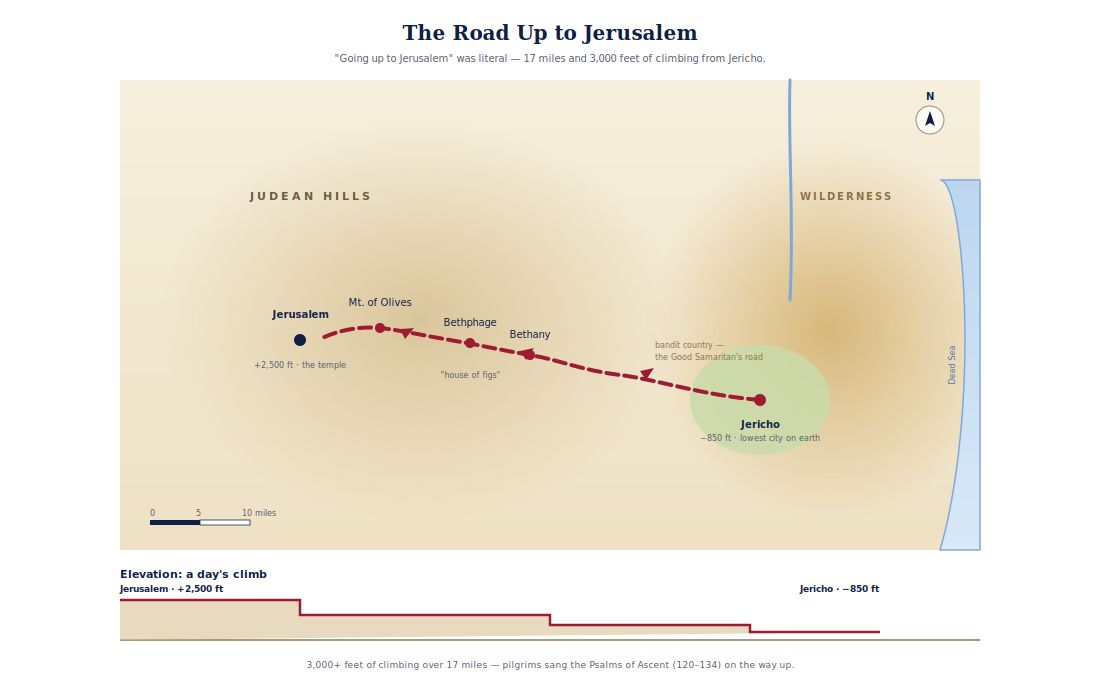
They're on the road — literally. "They were in the way going up to Jerusalem" (10:32), climbing 3,000 feet from the lowest city on earth to the city where everything will end. Jesus walks ahead of them, and Mark says the disciples were "amazed" and "afraid." They should be. He has just told them, for the third time and in the most detail yet, exactly what Jerusalem holds: betrayal, mocking, scourging, spitting, death — and resurrection.
What follows is Mark's most ironic stretch: two disciples ask for thrones, ten get indignant, and the only person on the road who actually sees is a blind beggar. At the center of it all stands one verse — 10:45 — the sentence the entire Gospel has been driving toward.
CHECK WHAT YOU THINK YOU KNOW
- ☐ "The disciples finally understood about the cross by now." (They ask for thrones in the very next scene.)
- ☐ "James and John were punished for their arrogant request." (Jesus doesn't rebuke them — He redirects them.)
- ☐ "'Ransom' means Jesus paid off the devil." (That's one old theory — influential for centuries, but never church dogma.)
- ☐ "Bartimaeus was just another healing story." (He's the only person in Mark who gets the title right and follows.)
Where we are in the story
Part 2 of Mark is a road trip with a destination: Jerusalem, where the Passover — and the cross — wait. They've left Galilee behind. The next stop is Jericho, an ancient oasis city about 17 miles northeast of Jerusalem, sitting nearly 900 feet below sea level — the lowest city on earth. From Jericho the road climbs steeply: 17 miles and 3,000 feet of elevation to Jerusalem. Pilgrims called it "going up" to Jerusalem, and they meant it literally.
Check What You Think You Know
Many sincere Christians have heard greatness in God's kingdom as a bigger platform — more influence, a larger ministry, a seat closer to Jesus. James and John asked for exactly that (10:37). But Jesus redefined greatness on the spot: "whosoever will be great among you, shall be your minister" (10:43) — and then He became the definition: "the Son of man came not to be ministered unto, but to minister, and to give his life a ransom for many" (10:45). In Jesus' kingdom, the way up is down, and the King Himself went lowest of all.
Scene 1: The third prediction — in full color (10:32–34)
"Behold, we go up to Jerusalem; and the Son of man shall be delivered unto the chief priests, and unto the scribes; and they shall condemn him to death, and shall deliver him to the Gentiles: and they shall mock him, and shall scourge him, and shall spit upon him, and shall kill him: and the third day he shall rise again." (10:33–34)
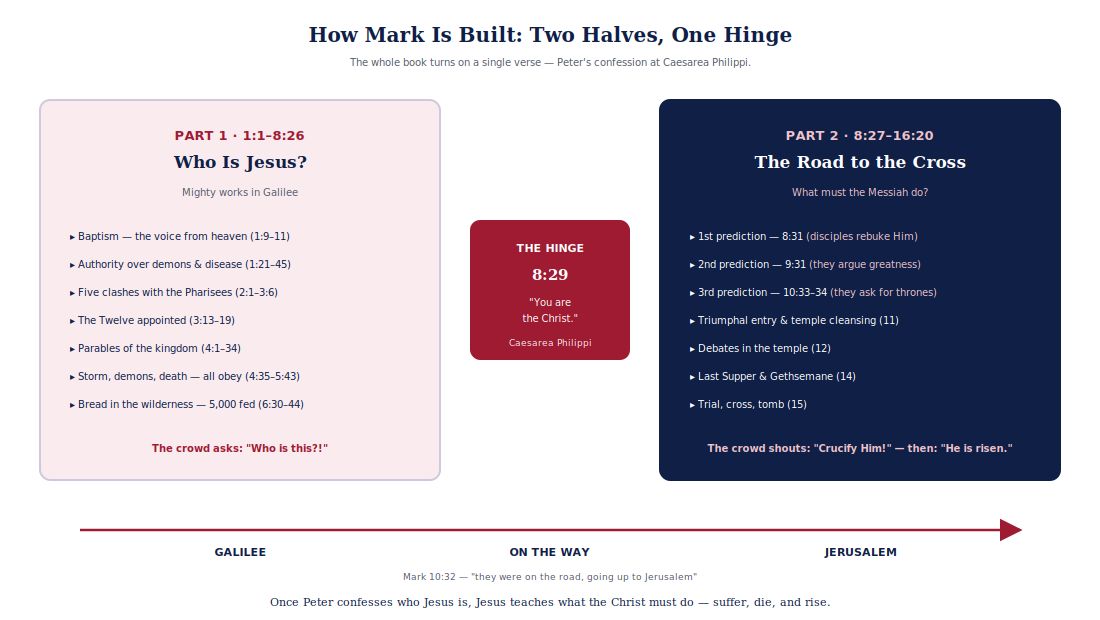
This is the third passion prediction (after 8:31 and 9:31), and the most detailed — seven verbs of suffering, then resurrection. The chief priests (the temple aristocracy) and scribes (the Bible scholars) are Jerusalem's religious establishment; the Gentiles means the Romans, who alone could carry out crucifixion. Jesus names the whole chain: Jewish leaders condemn, Roman soldiers execute.
And the disciples' reaction? "They were amazed; and as they followed, they were afraid" (10:32). Mark doesn't explain — but you can feel it. Their Master is walking toward the horror He's describing, and He's walking ahead of them.
Scene 2: Thrones for the thunder-boys (10:35–40)
Then James and John, the sons of Zebedee — the "Sons of Thunder" (3:17) — come with a request: "Master, we would that thou shouldest do for us whatsoever we shall desire... Grant unto us that we may sit, one on thy right hand, and the other on thy left hand, in thy glory" (10:35, 37).
Read that against what Jesus just said. He described mocking, scourging, spitting, death. They heard: kingdom, glory, thrones. The places of highest honor — at the King's right and left. They want the crown without the cross.
Jesus' answer is gentle but devastating: "Ye know not what ye ask. Can ye drink of the cup that I drink of, and be baptized with the baptism that I am baptized with?" (10:38).
- The cup — in the Old Testament, the "cup" is God's judgment, the cup of His wrath (Psalm 75:8; Isaiah 51:17). Jesus is asking: can you drink suffering?
- The baptism — not water baptism here, but being overwhelmed, submerged in suffering (see Luke 12:50).
"We are able," they say — with total, confident, utter misunderstanding. Jesus tells them the sobering truth: "Ye shall indeed drink of the cup that I drink of..." (10:39). And history proved Him right: James would become the first apostle martyred — executed by Herod Agrippa (Acts 12:2). John would be exiled to Patmos for his testimony (Revelation 1:9). They got their wish, in the way they least expected.
"But to sit on my right hand and on my left hand is not mine to give; but it shall be given to them for whom it is prepared" (10:40) — even the Son leaves the seating chart to the Father.
Scene 3: Greatness redefined (10:41–45)
The other ten hear about it — "they began to be much displeased with James and John" (10:41). Displeased, notice, not because the request was wrong — but because they didn't think of it first. All twelve want thrones.
So Jesus calls them together and flips the world's ladder upside down:
"Ye know that they which are accounted to rule over the Gentiles exercise lordship over them; and their great ones exercise authority upon them. But so shall it not be among you: but whosoever will be great among you, shall be your minister: And whosoever of you will be the chiefest, shall be servant of all." (10:42–44)
The Roman world ran on dominance — patronage, power, pecking orders. Jesus says: not here. In His kingdom, greatness is measured in towels, not titles. And then the reason — the verse the whole Gospel has been driving toward:
"For even the Son of man came not to be ministered unto, but to minister, and to give his life a ransom for many." (10:45)
Every theme of Mark converges here: the Son of Man (Daniel 7's glorious figure) redefined as the Servant (Isaiah 53's suffering figure); authority expressed as service; the cross as a ransom — lutron, the price paid to free a slave or captive. Jesus doesn't just teach the upside-down kingdom. He is it — and He'll prove it within days, on a cross outside Jerusalem.
Scene 4: The blind man who sees (10:46–52)
They reach Jericho, and as the crowd pours out, a blind beggar sits by the roadside: Bartimaeus — Mark even translates it: "the son of Timaeus" (10:46). (Mark translates Aramaic names for his Roman readers — another fingerprint of his Gentile audience.)
Hearing it's Jesus of Nazareth, Bartimaeus shouts: "Jesus, thou Son of David, have mercy on me!" (10:47).
Stop there. "Son of David" is a messianic title — the promised King from David's line. Peter confessed "Thou art the Christ" (8:29); the demons shrieked His divine titles. But this is the first time in Mark that an ordinary person publicly calls Jesus the Davidic Messiah — and it's a blind beggar. The crowd tries to shush him. He shouts "all the more."
Jesus stops. "Call him." And Bartimaeus — in Mark's most cinematic detail — "casting away his garment, rose, and came to Jesus" (10:50). His cloak was likely his only possession, his blanket, his beggar's mat for collecting coins. He throws it away to get to Jesus.
"What wilt thou that I should do unto thee?" — the same question, essentially, Jesus asked James and John (10:36). They wanted thrones. Bartimaeus answers: "Lord, that I might receive my sight" (10:51). Rabboni — "my dear teacher," deeper and more personal than "rabbi."
"Go thy way; thy faith hath made thee whole." And "immediately he received his sight, and followed Jesus in the way" (10:52).
Mark's irony is complete: the two disciples who see are blind to the cross; the beggar who is blind sees the Messiah — and having received sight, he does what disciples do: he follows. On the road. Toward Jerusalem. Toward the cross.
WORD STUDY
Ransom — lutron (LOO-tron). The price paid to free a slave, a captive, or a prisoner of war. When Jesus says He gives His life as a lutron "for many," He's saying His death purchases freedom — the cross is a transaction, and we are the ones bought back. ("For many" is the Hebrew idiom for the whole company — see Isaiah 53:11–12.)
Cup — poterion (poh-TAY-ree-on). In the prophets, the cup is God's judgment poured out (Psalm 75:8; Isaiah 51:17; Jeremiah 25:15). When Jesus asks James and John if they can "drink the cup," He's asking if they can drink suffering — and in Gethsemane He'll pray for that cup to pass (14:36).
Rabboni — (rahb-boh-NEE). Aramaic for "my teacher" — warmer and more personal than "rabbi." Only two people use it in the Gospels: Bartimaeus here, and Mary Magdalene at the empty tomb (John 20:16). Both times, it's the cry of someone who has just been given back what was lost.
Son of David — the messianic title for the promised King from David's line (2 Samuel 7:12–16). Bartimaeus is the first ordinary person in Mark to use it of Jesus — the blind man confesses what the seeing leaders will deny.
The third prediction — why so much detail?
Each passion prediction gets more specific: 8:31 ("suffer... be rejected... be killed"), 9:31 ("delivered into the hands of men"), and now 10:33–34 names the betrayal, the Jewish leaders, the Gentiles, the mocking, scourging, spitting — seven verbs of humiliation before the resurrection. Mark is doing two things: proving Jesus was never surprised (the cross was plan, not accident), and deepening the scandal — because the more detailed the prediction, the more shocking the disciples' response. They hear "glory" and ask for thrones.
"We are able" — the bravest, blindest answer in Mark
Jesus doesn't mock James and John. He tells them the truth: you will drink the cup — James martyred, John exiled. There's pastoral gold here: God sometimes grants our bold prayers in ways we never imagined, and the granting is grace, not punishment. Their thrones became testimonies.
Who gets the ransom? — handling 10:45 with care
"To give his life a ransom for many." The church has always confessed that Christ's death ransoms us. From what? Paid to whom? — that's where theologians differ, and Mark doesn't say. The idea that the ransom was paid to the devil was developed by Origen in the third century and vividly illustrated by Gregory of Nyssa — God tricking Satan the way a fisherman hides a hook inside bait (Christ's humanity the bait, His divinity the hook). 102103104 It was influential for centuries in the East, but it was never church dogma: Gregory of Nazianzus objected sharply ("to the devil? Outrageous!"), 105 and the West eventually moved on with Anselm. 106 What Mark does say is enough: we were captives, the price was His life, and the freedom is real. Don't press the metaphor further than Mark does.
Bartimaeus — the disciple the Twelve weren't yet
Notice the contrasts Mark stacks: James and John ask "do for us whatsoever we shall desire" (10:35) — self-serving. Bartimaeus is asked "What wilt thou that I should do unto thee?" (10:51) — and asks only for sight. The Twelve want status; the beggar wants Jesus. And when Bartimaeus receives sight, he "followed Jesus in the way" — the Greek hodos (road/way) is the same word the early church used for the Christian life itself ("the Way," Acts 9:2). The blind man becomes the model disciple: he cries for mercy, casts aside everything, receives sight, and follows — toward the cross.
The Christ Thread
Christ in His own story. Mark 10:45 is the verse the whole Gospel has been driving toward: Daniel 7's glorious Son of Man redefined as Isaiah 53's suffering Servant — one person, both identities. "Son of David" (10:47) claims the Davidic covenant (2 Samuel 7): the promised King has arrived. And lutron — ransom — is exodus language: the price that buys captives out. Israel was ransomed from Egypt; now the Son pays the ransom for "many."
OT/NT parallels — where the New Testament picks it up. Isaiah 53:11–12 ("My righteous servant shall justify many") stands directly behind "a ransom for many." Paul: Christ "gave himself a ransom for all" (1 Timothy 2:6). Peter: "redeemed...with the precious blood of Christ" (1 Peter 1:18–19). John, at the throne: "Thou... hast redeemed us to God by thy blood" (Revelation 5:9). Mark 10:45 is the seed; the epistles are the tree.
The Christian future — what this foreshadows for us. "With persecutions...and in the world to come eternal life" (10:29–30): the road runs through suffering to glory — the pattern of every believer (Romans 8:17). And Bartimaeus's ending is the Christian life in miniature: mercy cried for, sight received, cloak abandoned — "he followed Jesus in the way" (10:52). The road ends at the heavenly Jerusalem (Revelation 21–22), where the ransomed walk with the Ransomer.
Where in the Covenant Story?
Three covenants converge on this road. The Davidic covenant (2 Samuel 7:12–16) — "Son of David" is its direct claim: the eternal King from David's line, arriving as a Servant. The Mosaic covenant's exodus pattern — God "redeemed" Israel from Egypt (Exodus 6:6) — is the backdrop for lutron: ransom is how God has always freed His people. And dead ahead lies the New Covenant: within days Jesus will lift the cup and say "this is my blood of the new testament" (14:24). This road doesn't just lead to Jerusalem — it leads to the covenant-sealing cross.
Father, Son, and Spirit
"To sit on my right hand and on my left hand is not mine to give; but it shall be given to them for whom it is prepared" (10:40) — the Son's deference to the Father, even over glory's seating chart. The Father prepares; the Son obeys; neither grasps. It's the Trinity's mutual humility — and the exact pattern Jesus commands in 10:43–44: greatness through deference, not dominance. The God who is servant-shaped calls servants. (Mark doesn't foreground the Spirit here — the passage's Trinitarian moment is the Father-Son dynamic. Honesty over symmetry.)
WHAT THE CHURCH HAS ALWAYS BELIEVED: The church has always confessed that Christ's death was for us — "was crucified... for our sins" (1 Corinthians 15:3). Mark 10:45 is where Jesus says it Himself, before any creed existed: His life, our ransom. Every atonement theory since is commentary on this verse.
It's Okay to Ask
Honest questions this passage raises — bring them, don't bury them:
- Did James and John get in trouble for asking? (No — Jesus redirected, He didn't rebuke. Bold asks aren't the problem; blind asks are. And He answered with hard truth about their future: "Ye shall indeed drink of the cup.")
- If Jesus paid a ransom, who got paid? (Mark doesn't say — and the church decided not to speculate beyond the text. See "Who gets the ransom?" above. What matters is settled: captives freed, price paid, freedom real.)
- Why did Jesus ask Bartimaeus what he wanted — didn't He know? (He knew. He wanted Bartimaeus to say it — faith speaks. And He wanted the contrast on record: thrones vs. sight.)
FACT, INFERENCE, OR DISPUTED?
- FACT: Mark records three passion predictions (8:31; 9:31; 10:33–34), each more detailed than the last.
- FACT: Lutron means a price paid to free a captive or slave; "for many" echoes Isaiah 53's "many."
- INFERENCE: Mark places the thrones-request immediately after the third prediction to expose the disciples' blindness — the literary contrast is deliberate.
- DISPUTED: To whom (if anyone) the "ransom" is paid. The "paid to the devil" reading (Origen, Gregory of Nyssa) was influential but never official dogma, and theologians frame it differently. 107108 Mark's point — captives freed at the cost of Christ's life — is not disputed.
SCHOLAR'S NOTE: Jericho in Jesus' day was actually two cities: the ancient mound (Old Testament Jericho) and Herod the Great's luxurious winter palace complex nearby, with its pools and gardens. When Mark says Jesus passed "through Jericho," the crowd around Him likely included pilgrims heading up to Passover — which explains the large crowd suddenly present in 10:46. The road from Jericho to Jerusalem was notoriously dangerous (it's the setting of the Good Samaritan's parable in Luke 10) — bandit country, steep ravines, a full day's climb.
Cross-references (explained, not just listed)
- Isaiah 53:11–12 — the Suffering Servant "bears the iniquities of many" — the background of "a ransom for many."
- Daniel 7:13–14 — "one like the Son of man" given eternal dominion — the glory side of Jesus' favorite title, now fused with Isaiah's Servant.
- Psalm 75:8; Isaiah 51:17 — the "cup" of God's wrath; the cup Jesus drinks at the cross.
- Acts 12:2; Revelation 1:9 — James martyred, John exiled: "ye shall indeed drink of the cup."
- 2 Samuel 7:12–16 — the Davidic covenant behind "Son of David."
Go Deeper
Hungry for more? Two doors worth opening:
- Read Philippians 2:5–11 — the servant's descent and exaltation: the theology inside Mark 10:45, sung as a hymn.
- Read Isaiah 53 — the Servant's ransom, in full: "He was wounded for our transgressions."
Theological truth (arising from the text)
Greatness in God's kingdom is measured in service, not status — because the King Himself came as a slave and paid the slave's price. The cross is not a tragedy that interrupted Jesus' mission; it is the mission: the ransom that frees captives. And spiritual sight belongs to those who cry for mercy, not those who claim thrones.
Humble — and confident
Humble, because we are the captives in this verse, not the heroes. The ransom wasn't paid for people who had it together — it was paid for rebels and beggars. And because James and John remind us how easily "greatness" becomes throne-grabbing, even (especially) in ministry.
Confident, because the price is paid. Not pending, not partial — "a ransom for many" means the transaction is finished. If you are in Christ, your freedom isn't aspirational; it's purchased.
Confess It
James and John wanted thrones; the ten were indignant they didn't ask first — twelve throne-grabbers, zero servants. Name your own throne-grabbing: the recognition, position, or control you chase. Confess the ambition (1 John 1:9) — then ask for Bartimaeus's eyes instead of James and John's.
For discussion
- Jesus redefines greatness as servanthood and slavery (10:43–44). Where in your life — home, work, church — are you most tempted to "lord it over" instead of serve?
- Bartimaeus "casting away his garment" — his only security — to get to Jesus. What's your "cloak": the safety you'd have to drop to really follow?
- "We are able," said James and John — and God took them at their word, in ways they never imagined. Is there a bold prayer you've prayed that God might be answering differently than you expected?
What He has done (the indicative)
Before one "you should," hear what He did: the Son of Man walked ahead of frightened disciples toward mocking, scourging, spitting, death — and did it for us. He did not come to be served but to serve, and the serving went all the way to a ransom: His life for our freedom. Bartimaeus cried for mercy and got sight; the same mercy is offered to you, right now. Every step below is response to that, not a way to earn it.
This week's practices
- The towel test. One deliberate act of hidden service this week — something no one will thank you for, that puts you "below" someone else. Do it without telling anyone.
- Cloak inventory. Write down the one security you clutch hardest (savings, reputation, control, a relationship). Pray Bartimaeus's prayer over it: "Jesus, thou Son of David, have mercy on me" — and ask what throwing it aside would look like.
- Pray It Back. Take Bartimaeus's cry into prayer each morning: "Jesus, Son of David, have mercy on me — especially in _____. Then sit still long enough to hear His question back: 'What wilt thou that I should do unto thee?'
- Memorize Mark 10:45. The Gospel in one verse. Say it until you can say it from memory, then say it to someone else.
- Follow "on the road." Take one 30-minute walk this week with no phone, meditating on 10:32 — Jesus walking ahead of frightened disciples toward Jerusalem. What is He walking ahead of you toward?
For Us Together
Ask your small group or one friend this week: "Where do we 'lord it over' each other — even subtly? What would towels-not-titles look like in our group this month?"
Who Needs This?
Who in your life is spiritually blind but doesn't know it — or blind and crying out? One name. Bring them to Jesus the way the crowd brought Bartimaeus: "Be of good comfort, rise; he calleth thee" (10:49).
Take It Home
At the table or at bedtime, ask your kids: "Jesus said the greatest person is the servant. Who served you today? Who did you serve?" Then tell them about one hidden act of service you did this week. They'll remember what they see longer than what they hear.
Praise Him
Don't end with a to-do list — end with worship. Right now, out loud or in writing, finish this sentence: "Lord Jesus, I praise You because You paid _____." (My ransom? The slave's price? With Your own life?) Sit in it for a minute. Theology that doesn't become doxology hasn't finished its work.
The bottom line
The Son of Man didn't come to collect service but to give it — and the giving went all the way to a cross, where His life became the price of our freedom. Greatness is a towel. Discipleship is a road. And the blind beggar who cried for mercy sees more clearly than the apostles who asked for thrones.